Introduction: The Journey from Builder to Boardroom
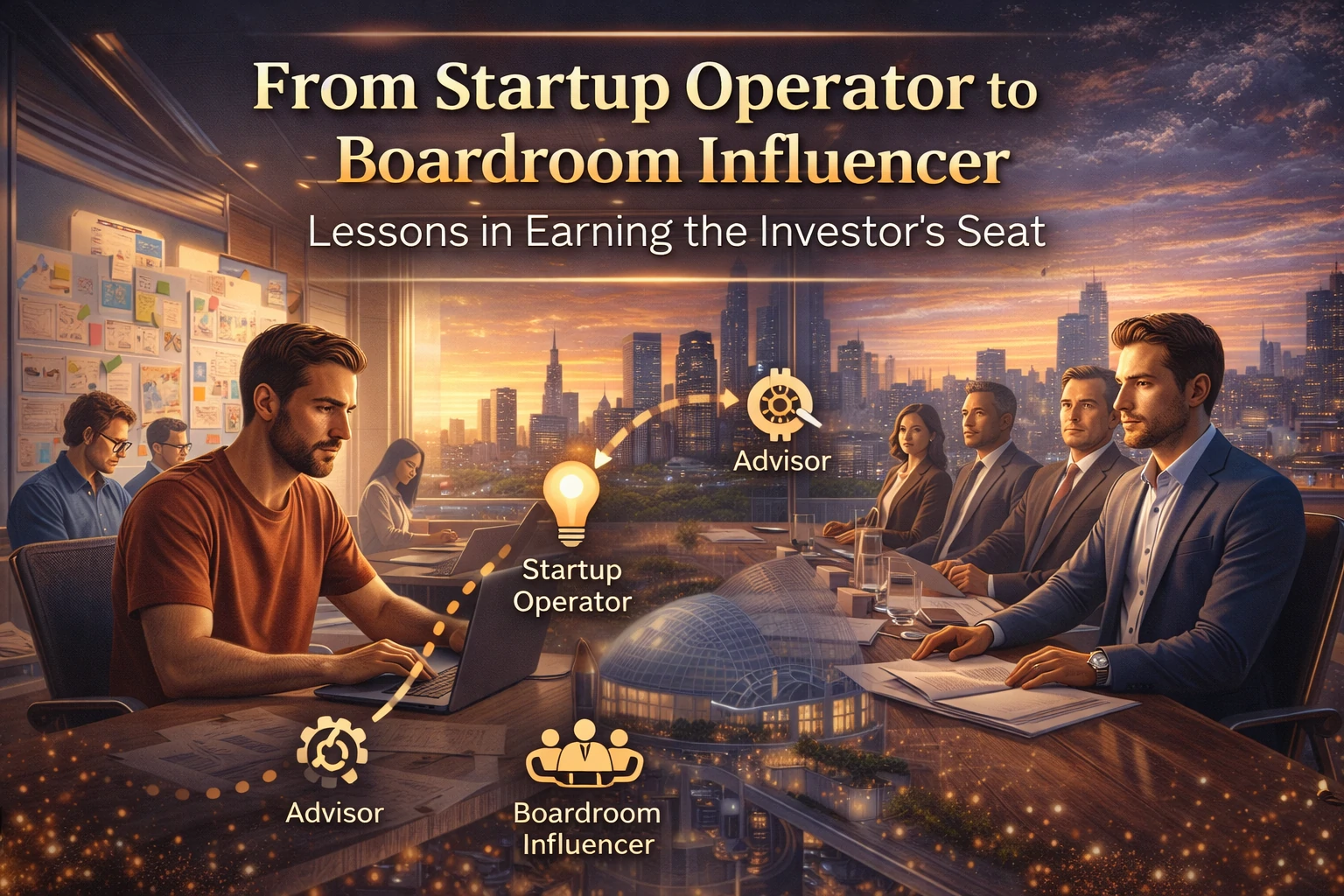
Every founder starts with an idea, a pitch deck, and relentless optimism. But what happens after the exits, pivots, or burnouts? For those who play the long game, the next level isn’t just launching more ventures—it’s earning influence in the rooms where capital, vision, and governance collide: the boardroom.
My own journey from startup operator to board advisor taught me a core truth: success in the boardroom requires more than entrepreneurial experience—it demands strategic empathy, trust capital, and governance fluency.
This is not a linear upgrade. It’s a transformation. One that demands emotional intelligence, pattern recognition, and a new language—governance.
In this article, I share actionable insights for startup founders, operators, and rising leaders who want to evolve into trusted advisors and investor board members. Whether you’re in Southeast Asia or Silicon Valley, these principles apply.
Chapter 1: Operator Mindset vs. Advisor Mindset
Being a founder is about building, scaling, and surviving. You are deep in the trenches—hiring, fundraising, selling, fixing bugs at 2AM. It’s a relentless dance between execution and resilience. You measure wins by how fast you move and how long you can last.
Board members, on the other hand, operate on a different plane:
- They guide, but don’t manage.
- They ask better questions than they give answers.
- Their currency is judgment, not hustle.
- They are accountable not just to the business, but to its ecosystem of stakeholders.
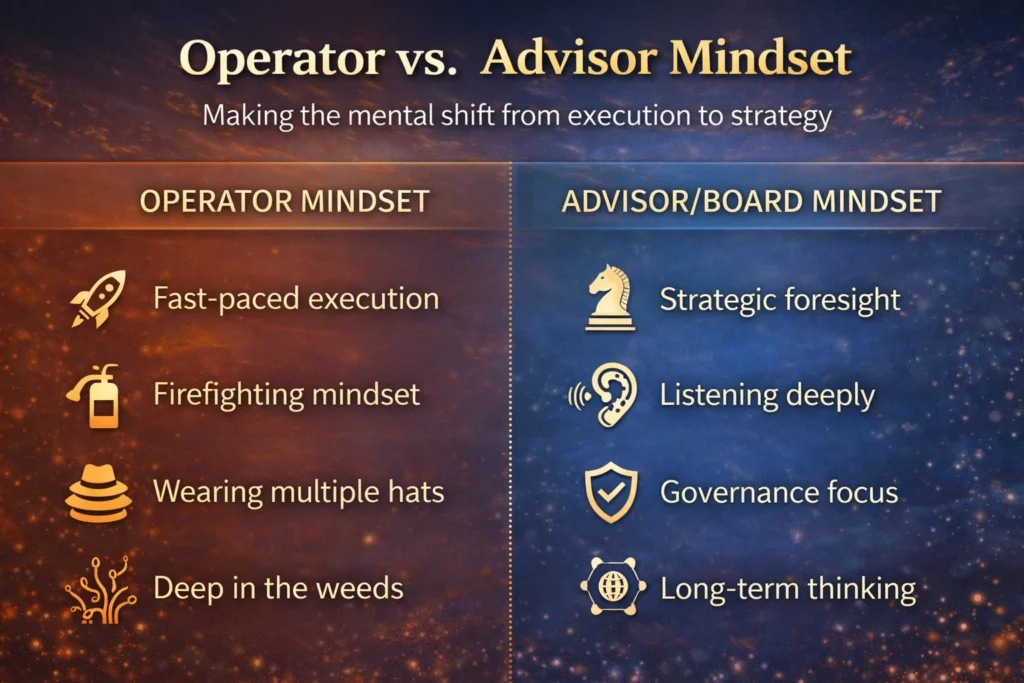
Operator Mindset:
- Execution-led
- Metrics-driven urgency
- Tactical problem solving
- Emotional attachment to outcomes
- Wearing multiple hats daily
- Reacting quickly to dynamic situations
Advisor/Board Mindset:
- Strategic foresight
- Risk calibration
- Long-term stakeholder alignment
- Emotional neutrality
- Focused influence from a distance
- Prioritizing questions over answers
Making the shift means learning to zoom out, to delay your instinct to fix, and to think not as a founder—but as a steward of sustainable value.
This mental shift doesn’t happen overnight. It requires deliberate exposure to how boards think and decide—often at a very different pace and perspective than startup life demands.
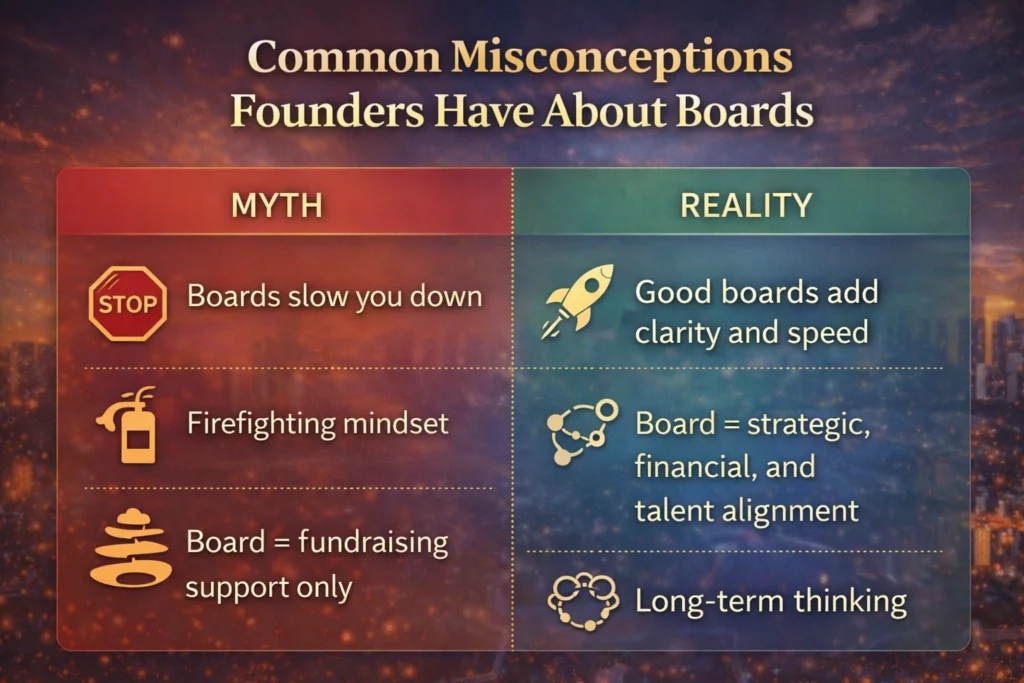
Chapter 2: What Founders Often Get Wrong About Boards
Founders often misunderstand the true role of the board. In early-stage startups, the board is typically a collection of friends, angels, and the occasional VC partner. But as a business matures, its board must evolve into a strategic asset.
Common Misconceptions:
- “Boards just approve what founders want.”
In truth, good boards challenge assumptions, provide outside-in clarity, and hold leadership accountable. They don’t rubber-stamp; they refine. - “The board only matters during fundraising or exits.”
Actually, boards should engage across all phases—from pivots and talent decisions to pricing models and expansion risks. Strategy isn’t seasonal. - “Governance slows us down.”
Poor governance slows you down. Good governance provides discipline, clarity, and optionality. - “I don’t need a formal board until Series A or later.” Waiting too long to build board discipline leads to messy power dynamics and poor decision hygiene.
Boards aren’t just passive overseers—they’re strategic mirrors. They reflect what leadership might miss, ask questions no one else dares, and protect the mission from derailment.
Understanding this early will help you build a board culture that others want to be part of—and eventually, help you sit on someone else’s board with insight, not ego.
Founders should see their board not as a threat or formality, but as a strategic amplifier—one that, when used wisely, makes the company smarter, more stable, and more scalable.
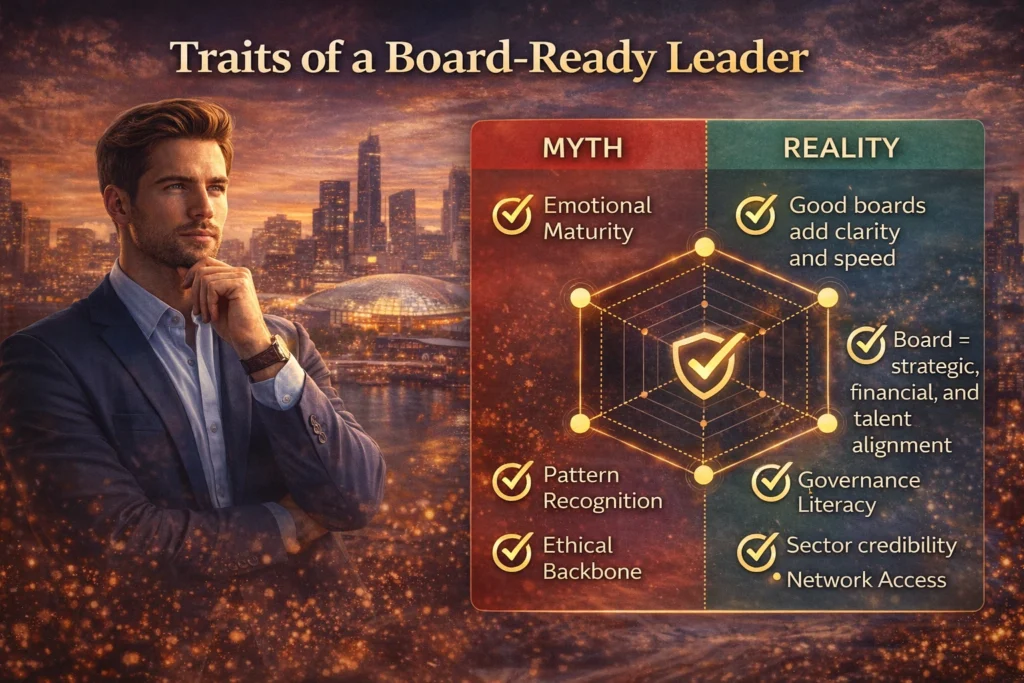
Chapter 3: Traits Investors Look for in Future Board Members
To earn a board seat, especially as a startup operator, you must demonstrate value beyond your own venture. Investors and institutional funds are deeply selective about who joins their boards.
What do they look for?
- Pattern Recognition
Have you experienced multiple business cycles? Have you seen both product-market fit and failure? Can you identify signals before others see them? - Emotional Maturity
Can you handle heated boardroom discussions without defensiveness? Are you capable of coaching founders without overshadowing them? Have you demonstrated calm in chaos? - Network Leverage
Do you have the ability to attract capital, close senior hires, or unlock strategic partnerships? Are you a bridge-builder across ecosystems? - Governance Literacy
Do you understand the duties of care, loyalty, and disclosure? Can you help a startup navigate compliance, structure committees, or handle crisis scenarios? - Sector Credibility
Are you seen as a domain expert? Do you bring insights in fintech, healthcare, sustainability, deep tech, or another specialized field? Can you become the board’s go-to expert? - Time Discipline
Boards aren’t just symbolic. They require attendance, preparation, and decisions. Do you show up consistently? Are you organized, responsive, and proactive? - Ethical Backbone
When things go wrong, will you protect integrity over popularity? Will you raise red flags if needed? Can you call out toxic behavior with tact and courage?
These aren’t traits you claim. They’re traits you earn—and demonstrate through real interactions, crisis navigation, and stakeholder trust.
Being board-ready means training your muscles in silence before the invitation arrives. Start now. Because the best board seats often go to those who’ve already been acting like a board member long before they were officially invited.
Chapter 4: Lessons from My Transition — Founder → Advisor
Stepping from a founder’s chair into a board seat was not just a career move—it was a psychological rewiring. I had to trade adrenaline for patience, tunnel vision for wide-lens thinking, and urgency for stewardship.
- Zooming Out
I was used to sprinting. Every week brought new fires. But boards operate in marathons. I had to expand my time horizons and stop mistaking noise for signal. Quarterly cadence, horizon planning, and anticipating macro risk became part of my mental model.
- Listening with Presence
Founders are often surrounded by people who talk at them. The best board members listen—not to respond, but to understand. They don’t just catch what’s said, but sense what’s unsaid. In my transition, I trained myself to speak last—and only if it added clarity.
- Supporting Without Coddling
The role of an advisor isn’t to fix problems but to frame them better. I stopped giving advice and started offering structured choices. I learned to say, “Here are two ways this could go,” instead of “Here’s what I’d do.”
- Being Useful Without Being Loud
The real work of board members often happens between meetings. I began making quiet introductions, sending relevant articles, helping with key hires, and advising on market timing. Subtle support earns founder trust.
- Understanding Board Politics
Even boards have power centers. You must learn how to navigate alliances, hidden tensions, and influence nodes. The smartest board members often shape outcomes before meetings through 1:1s, backchannel diplomacy, and pre-read positioning.
This transition was humbling. But it allowed me to shift from being a builder of one company—to a multiplier of many.
Chapter 5: How to Prepare Yourself for Board Influence
There’s no official playbook to becoming a board member. But there is a path of intent. Here’s how to build your board-readiness:
- Build a Thought Leadership Footprint
Thoughtful writing builds trust at scale. Write about:
- Founder-investor alignment
- Lessons from failure
- Startup mental health
- Market predictions
- Governance and ethics in startups
Well-articulated ideas get remembered—and shared by VCs, LPs, and founders.
- Practice Shadow Governance
If you’re already an investor or mentor, ask to sit in on board meetings. Observe:
- How board packs are structured
- How conflicts are mediated
- How underperformance is addressed
This gives you boardroom literacy without pressure.
- Start Local, Think Global
Join local boards—universities, charities, chambers of commerce. These are fertile grounds for:
- Understanding board procedures
- Practicing governance
- Developing stakeholder communication
Then scale up to startup advisory boards and investor-backed companies.
- Network with Intent
Boards often recruit via referrals. Get visible to:
- Managing partners at VC firms
- Operating partners at PE firms
- Family office principals
- Startup studio founders
Be useful to these people before you pitch anything.
- Educate Yourself
Courses like:
- INSEAD International Directors Programme
- Harvard Business School’s Board Governance programs
- Thai Institute of Directors (IOD)
can provide the structure, credibility, and vocabulary you’ll need.
Board preparation is less about chasing a title, and more about becoming the person others trust when decisions get tough.
Chapter 6: Startup Boards vs. Corporate Boards
Both board types require governance, but their rhythm, culture, and expectations vary.
Startup Boards:
- Founder-led
- Often informal
- Focused on GTM, hiring, and fundraising
- Fewer members (3–7 typical)
- Agile, often meeting monthly
Corporate Boards:
- Investor or independent-led
- Formalized committees
- Concerned with compliance, shareholder value, ESG
- Larger boards (9–15 members)
- Slower cadence (quarterly, annually)
What You Must Learn:
- How committees (audit, compensation, governance) function
- The role of independent directors
- How public markets scrutinize board behavior
- Crisis communication protocols
For long-term influence, you need to bridge both worlds. If you can bring startup agility to a corporate board—and corporate discipline to a startup board—you become a rare asset.
Chapter 7: Thai vs. Global Boardroom Dynamics
Boardrooms aren’t just strategic—they’re cultural.
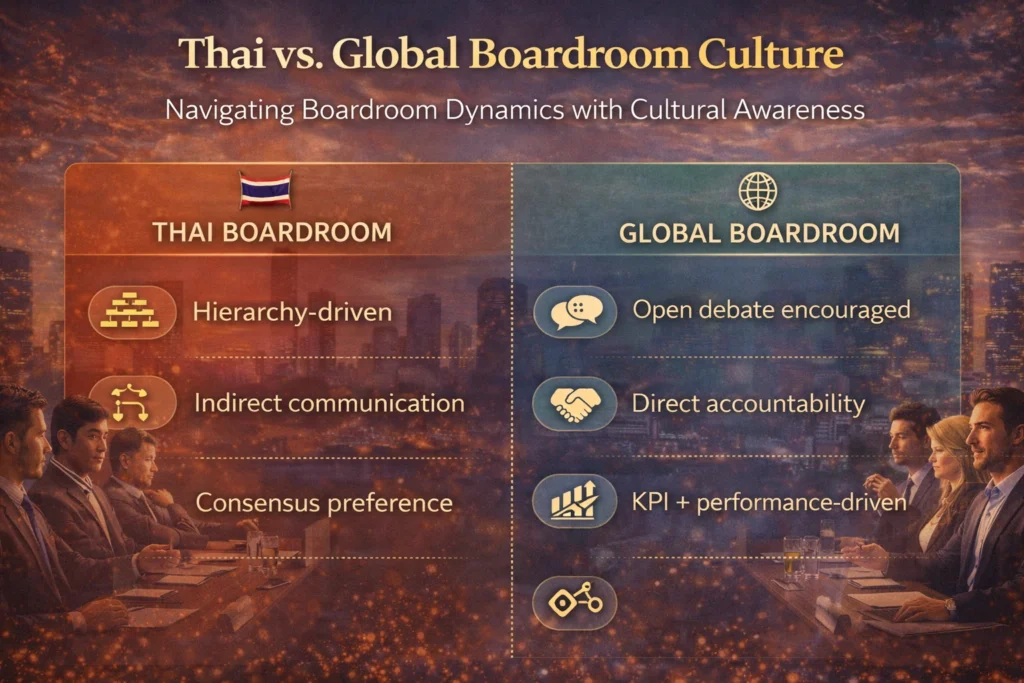
In Thai boards, you’ll often find:
- Deep deference to age and hierarchy
- Indirect communication styles
- Preference for harmony over confrontation
- High-context decisions made outside the boardroom
In Western boards (US/Europe):
- Independent directors challenge CEOs openly
- Dissent is seen as healthy
- Directors are expected to push back constructively
As Thailand becomes more global, boards are slowly adopting hybrid models. But cultural friction still exists.
Your Role as a Bridge:
- Translate expectations across cultures
- Prepare founders for investor questions
- Help global directors appreciate Thai etiquette
- Bring governance without Western arrogance
If you can dance in both styles, you’ll be called on for high-stakes roles where diplomacy and direction must coexist.
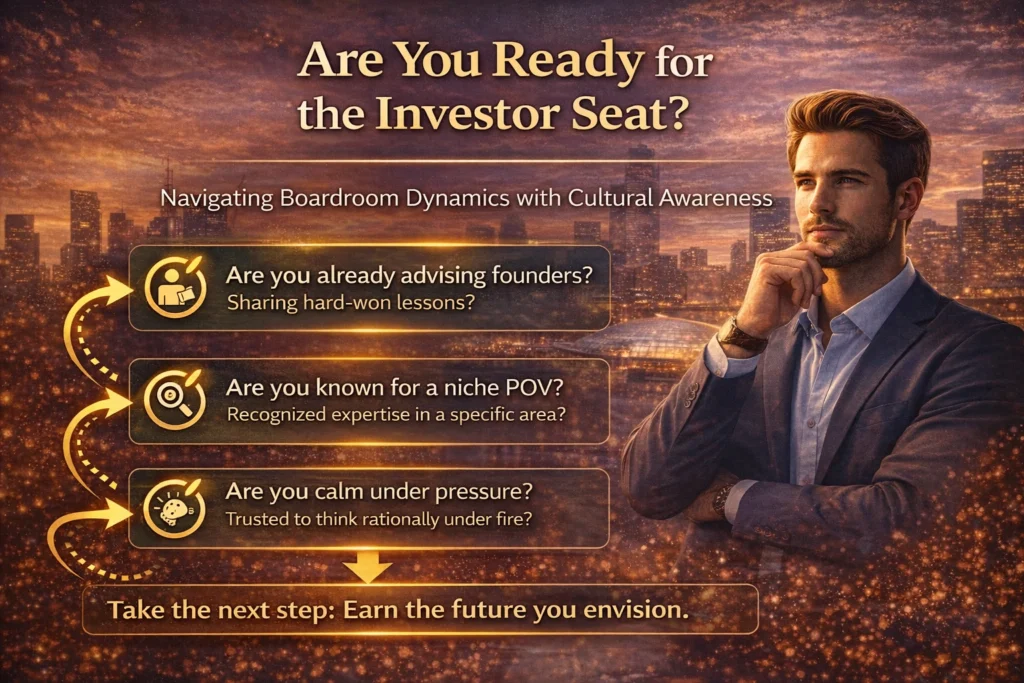
Chapter 8: Signals That You’re Ready for the Investor Seat
There’s no formal invite that says, “You’ve made it.” But these signs suggest you’re ready:
- You’re being asked to mentor other founders regularly
- You’re known for a specific expertise (e.g., GTM strategy, exits, M&A)
- You’ve supported a startup through more than one funding round
- Your name comes up in investor discussions
- You’re helping companies scale without needing spotlight
Other subtle signs:
- You’re comfortable with ambiguity
- You know how to navigate disagreements without ego
- You see your role as support, not savior
Ultimately, board influence isn’t about being right. It’s about making sure the company makes better decisions over time.
Conclusion: Influence with Integrity
The boardroom is a sacred space. One where strategy meets conscience, and where a single sentence can alter a company’s destiny.
If you’re a founder or operator eyeing the next chapter, consider this: Your scars, stories, and sensibilities are your assets. But they must be tempered by governance, maturity, and purpose.
To become a great board member:
- Show up prepared
- Stay intellectually humble
- Speak truth with empathy
- Put the company before your ego
Influence is not taken. It’s earned through trust, delivered through service, and remembered through impact.
The investor seat is not the end of the journey. It’s just the beginning of your legacy.
Are you ready?
#StartupToBoardroom #BoardAdvisor #StartupGovernance #InvestorSeat #AndeAditya #BoardroomBytes #FounderToAdvisor #ThaiStartupLeadership #GovernanceMatters