

Introduction: The Illusion of Balance
“Work-life balance” — we hear it at retreats, on HR posters, and in LinkedIn mantras. But for high performers, entrepreneurs, and creators navigating real deadlines, global markets, and personal ambition, balance often feels like a myth. Worse — it feels like a standard designed to make us feel guilty for being out of sync.
In this essay, I offer a new paradigm: rhythm over balance.
Drawing from neuroscience, Eastern philosophy, and my own experiences building and advising across Southeast Asia, I’ll explore why Thailand offers a unique canvas for work-life innovation — and how founders, leaders, and creators can redesign their routines for energy, clarity, and longevity.
This isn’t about doing less. It’s about designing smarter.
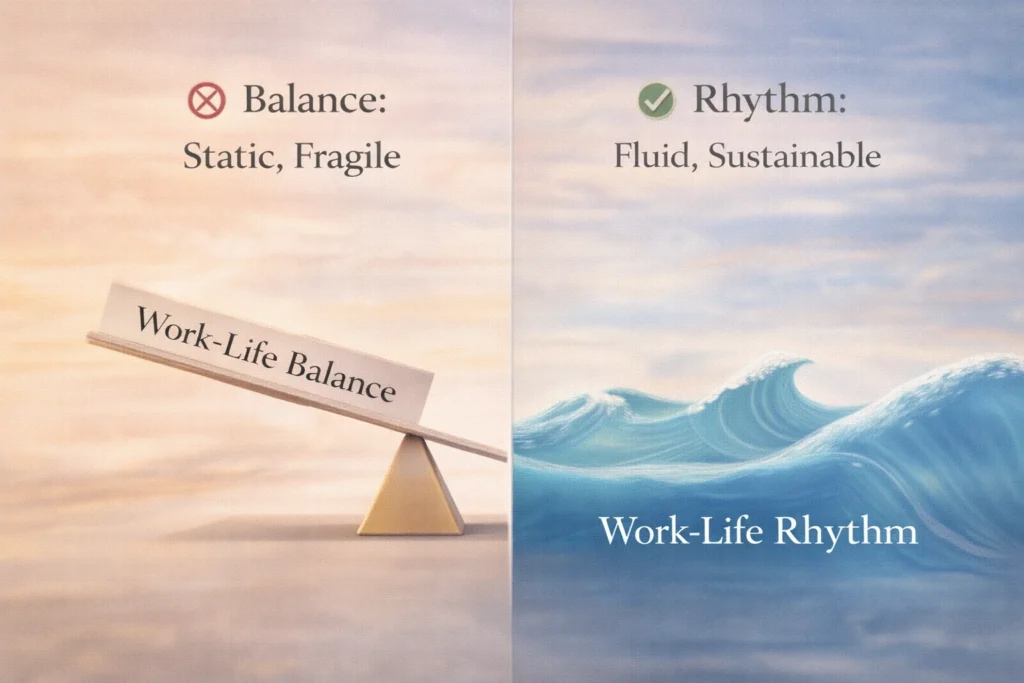
Chapter 1: Why Balance Is Broken
The modern idea of work-life balance emerged from industrial-era values: fixed hours, factory shifts, and a clean separation between work and home. It made sense for an age when productivity was linear, and time was money. But that model is outdated.
Today’s professionals are navigating an entirely different landscape — fluid, borderless, and always-on. The 9-to-5 model has given way to asynchronous workflows, global teams, side hustles, and digital-first branding. We no longer leave work at the office — because work follows us, in our pockets, through push notifications and content obligations.
In this environment, the idea of “balance” becomes performative — a curated image rather than a functional strategy.
Why High Performers Reject the Balance Narrative
For high achievers — startup founders, C-suite leaders, creatives, investors — the concept of balance often feels like a burden. It’s sold as a solution but experienced as a stressor:
- Am I meditating enough?
- Am I spending enough time with family?
- Should I log off earlier to prove I’m “balanced”?
The irony is that trying to live up to this model becomes another task on the to-do list.
More importantly, high performers don’t operate in symmetrical patterns. Their energy is dynamic. Their schedules are irregular. Their goals are exponential. Balance assumes stasis — but high performance thrives on motion.
The Rhythm Paradigm
This is where rhythm comes in.
Unlike balance, rhythm acknowledges intensity. It honors variation. It allows for intentional imbalance when the moment calls for it — a launch, a creative sprint, a funding round — and provides tools for recovery after the push.
Think of a musician. A great composition isn’t 50% sound, 50% silence. It’s a curated rhythm of tempo, pauses, crescendos, and rests. The same applies to leadership and performance.
In a rhythm model, we focus less on “how many hours did I work vs. rest” and more on:
- What is the quality of my energy right now?
- What phase am I in — expansion, recovery, ideation?
- Am I overextending or underchallenged?
The Asian Context: Why Balance Language Falls Short
In many Asian cultures, especially in Thailand, Japan, South Korea, and China, work carries deep cultural weight. Hierarchy, harmony, and endurance are highly valued. To leave early or admit burnout may be seen as weakness or disloyalty.
Thailand offers an interesting contradiction. On one hand, it’s known for its calm, spiritual undertone — the land of smiles, temples, and massages. On the other, Thai professionals can work long hours under high pressure, especially in urban hubs like Bangkok.
Here, balance isn’t just hard — it’s culturally complex.
In this setting, rhythm becomes a more useful model because it respects flow — not detachment. It allows people to show up fully during work seasons, then retreat into wellness without guilt. It honors the human behind the hustle.
Digital Pressure and the Myth of Always-On
Another factor breaking balance is digital immersion. The same tech that enables freedom also fosters constant exposure:
- Social media updates that spark comparison
- Notifications that fragment attention
- Algorithms that reward presence, not perspective
This is especially relevant for thought leaders and entrepreneurs trying to build a personal brand. The pressure to “always be visible” can sabotage genuine energy alignment.
Balance says: “Log off.” Rhythm asks: “When and how do I show up most effectively?”
Performance Without Burnout: What Really Works
In coaching high-performing founders and executives, I’ve noticed a few traits that rhythm thinkers share:
- They batch energy, not just time.
- They know their natural peak hours.
- They design recovery into their calendar.
- They treat self-awareness as a skill, not a luxury.
Rhythm isn’t passive. It’s intentional. And it evolves with your seasons — startup mode, scale mode, sabbatical mode.
Conclusion: Letting Go of the Balance Illusion
Balance sounds good. But for many, it’s just another expectation to manage.
What we need is a more fluid, human-centered model. One that blends ambition with awareness. Strategy with softness. Drive with downtime.
That model is rhythm.
In the next chapter, we explore how Thailand’s cultural and lifestyle rhythm offers a live case study for founders and creators around the world.
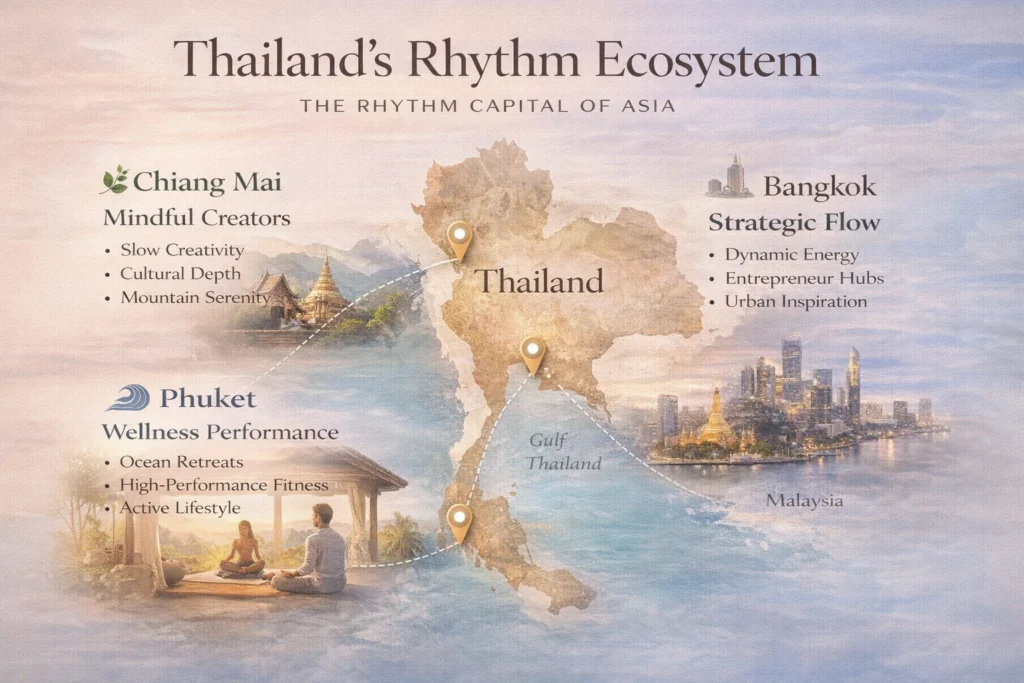
Chapter 2: Thailand as a Case Study in Rhythm > Balance
If rhythm is the new lens through which high performers should view their energy and time, then Thailand is the perfect laboratory to understand how this model thrives.
This country — often viewed as Southeast Asia’s lifestyle capital — embodies a fascinating blend of ancient wisdom and modern energy. On the surface, Thailand is known for tropical beaches, temples, and a slower pace of life. But dig deeper and you’ll find Bangkok’s global tech ambitions, Chiang Mai’s rising creator economy, and Phuket’s thriving community of digital nomads.
Across these regions, entrepreneurs are pioneering a new kind of work-life rhythm — one not constrained by traditional business hours, nor governed by Western productivity mantras. It’s a uniquely Thai approach that could hold valuable lessons for global founders.
-
The Thai Cultural Rhythm
In Thai culture, there’s a concept known as “sabai-sabai.” It loosely translates to calmness, comfort, or a sense of ease. Unlike hustle-centric cultures where pressure and speed are glorified, Thai society places high value on emotional equilibrium, hospitality, and flow.
This doesn’t mean people don’t work hard — they do. But there’s a deeply rooted cultural rhythm:
- Meals are unhurried.
- Smiles are offered before solutions.
- Personal wellbeing is intertwined with professional integrity.
This rhythm can feel disorienting to outsiders used to more transactional or fast-paced interactions. But it’s precisely this emotional cadence that offers a foundation for sustainable performance.
Thai work culture, particularly outside of hyper-urban hubs, doesn’t worship “busy” as a badge of honor. Instead, it prioritizes relational harmony, adaptability, and presence.
In the context of rhythm, this creates space for leaders to check in with their own flow — not just the market’s.
-
Bangkok: The Urban Pulse
Bangkok is a paradox. It moves fast — traffic, tech conferences, investor meetups. But it also knows how to pause. You’ll find monks walking silently for alms at sunrise just a few blocks from bustling co-working spaces.
Here, young entrepreneurs and corporate leaders are blending high performance with mindfulness:
- Morning runs at Lumphini Park
- Midday meditation at wellness studios
- After-hours business talks over minimalist cocktails
Many Bangkok-based founders follow a rhythm of high-intensity output during the week, followed by digital detox weekends in nearby provinces or islands.
The city encourages a tempo that is ambitious yet recoverable. Unlike 24/7 grind hubs, Bangkok rewards you for stepping away to reflect — and coming back sharper.
-
Chiang Mai: The Creative Sanctuary
Chiang Mai, in Northern Thailand, has become a global hotspot for digital nomads, remote founders, and creative professionals.
Why? Because it offers something rare in the entrepreneurial world: breathing space.
In Chiang Mai, you’ll find:
- Slow coffee shops with strong Wi-Fi and stronger ideas
- Retreats focused on design thinking, inner work, and innovation
- Founders who take afternoon breaks to journal or hike
Many creators design their lives around what’s known as seasonal rhythm: long productive winters, followed by travel-based summers, often synced with client flows or launch cycles.
The low cost of living, high quality of life, and access to both nature and community make Chiang Mai a rhythm powerhouse.
It’s no wonder it’s become a base for entrepreneurs redefining what success feels like — not just what it pays.
-
Phuket and the Wellness Executive Model
Phuket, traditionally seen as a vacation destination, has evolved into a lifestyle hub for entrepreneurs who blend performance with wellness.
Here you’ll find:
- High-end wellness resorts offering founder burnout recovery programs
- Boutique co-working villas with ocean views and built-in coaching
- Executives scheduling investor calls between Muay Thai sessions and yoga brunches
This is not just privilege — it’s intention.
High-performing leaders in Phuket often build rhythms that include:
- Morning movement rituals
- Afternoon deep work blocks
- Evening digital sunsets
They understand that strategic clarity doesn’t emerge from exhaustion — it requires space, health, and design.
In this way, Phuket offers a preview of what executive life could look like when health and hustle are not in conflict.
-
Thailand’s Rhythmic Advantage
When viewed holistically, Thailand isn’t just a beautiful place to rest — it’s a strategic geography to rethink performance.
Why?
- Time Zone Leverage: Aligned with Asia-Pacific and manageable for Europe
- Cost-Quality Ratio: High-quality living at sustainable costs
- Cultural Harmony: Built-in mindfulness and social grace
- Ecosystem Maturity: Growing startup and investment scene
Together, these factors create a fertile environment for designing and sustaining new rhythms — ones that support output and alignment.
Conclusion: What Global Leaders Can Learn from Thailand
Global founders often chase success at the cost of serenity. But Thailand shows us another way: a life where ambition and presence coexist.
By observing how Thai professionals, expats, and creators structure their days, we gain templates for rhythm:
- Rituals that ground, not distract
- Environments that energize, not deplete
- Community that accelerates, not competes
In the next chapter, we’ll dive deeper into how to design your own rituals, routines, and realignment systems — no matter where you live.
Because rhythm isn’t a place. It’s a practice.
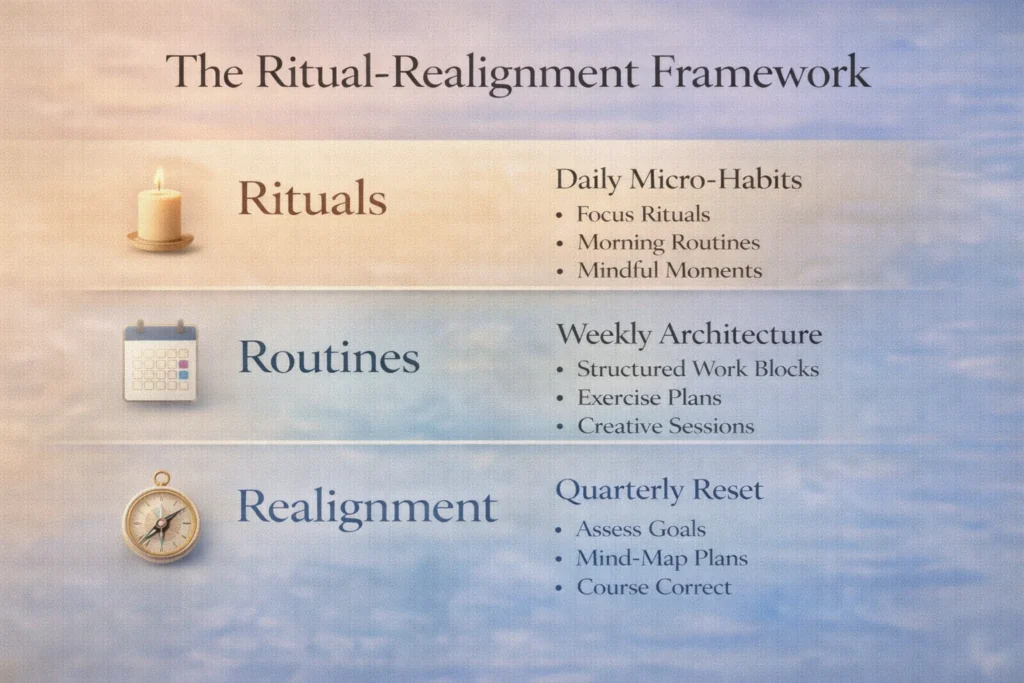
Chapter 3: Rituals, Routines, and Realignment for Leaders
When we shift from balance to rhythm, the conversation is no longer about how much time we spend working versus resting. It becomes about how we intentionally design our days, weeks, and seasons to align with our energy, values, and long-term outcomes.
This chapter focuses on the practical side of rhythm: how high-performers build rituals and routines not just to stay productive, but to stay connected to themselves.
Because true rhythm isn’t accidental. It’s architected.
-
The Power of Ritual in a Distracted Age
In a world of algorithmic nudges, ritual becomes rebellion.
Where habits are unconscious patterns, rituals are intentional anchors — micro-moments that give structure to chaos. They might seem simple: lighting incense before work, journaling after meetings, stretching before Zoom calls. But their power is in repetition and meaning.
Rituals signal to your brain: “This is sacred. This matters. Be here now.”
In the context of leadership, rituals create:
- Focus: They reduce cognitive load by reducing decision fatigue.
- Stability: They ground you when volatility rises.
- Identity: They reinforce who you are becoming — not just what you are doing.
Examples of founder rituals:
- Weekly check-in with a coach or co-founder
- Digital sunset at 8 p.m.
- “CEO Hour” every morning with no meetings
- Sunday night calendar intention setting
Rituals help you work on the business — not just in it.
-
Designing a High-Performance Routine
While rituals are micro, routines are macro — the recurring architecture of your day or week.
The best routines for high-performers are:
- Energy-matched — aligned to when you feel most alive
- Role-specific — tuned to your responsibilities
- Value-driven — prioritizing what actually matters
Framework: The 4-Part Founder Rhythm
- Ignition Block: First 90–120 minutes of the day — deep work, no meetings
- Engagement Block: Midday interactions — calls, team check-ins, sales
- Recovery Block: Afternoon dip — light admin, walking meetings, nap
- Reflection Block: End-of-day review, strategy, learning
These blocks can be stretched or compressed, but they create predictable containers for different energy states.
Pro tip: Design your week, not just your day. Have theme days:
- Mondays: Strategic planning
- Tuesdays/Wednesdays: External calls
- Thursdays: Deep content or product
- Fridays: Investor updates, networking
Routine is not rigidity. It’s freedom through rhythm.
-
Realignment: The Missing Piece in Burnout Recovery
Even with the best rituals and routines, we drift. Life shifts. Markets wobble. Personal energy wanes.
That’s why high-performers need a realignment protocol — a set of practices to check in, recalibrate, and shift course without spiraling.
Signs you need a realignment:
- You’re succeeding externally but feel disconnected internally
- You dread meetings that used to excite you
- Your creative output drops, even with more time
- You’re micromanaging or avoiding key decisions
Realignment tools:
- Quarterly solo offsite (1-2 days offline to reflect and reset)
- Monthly energy audit: What tasks drain vs. energize?
- Weekly journaling prompt: “What would more rhythm look like next week?”
- Daily body check-in: Are you holding stress? What does rest look like?
High performance is not just about speed — it’s about course correction.
-
Cultural Anchors: Blending East and West
Many of the world’s most effective routines borrow from Eastern philosophies:
- Stillness before action (Zazen meditation)
- Movement as medicine (Tai Chi, yoga, walking)
- Silence as power (Vipassana retreats)
Western productivity models often emphasize output. Eastern approaches emphasize alignment.
When blended, you get:
- Presence and performance
- Structure with softness
- Output that feels resonant, not rushed
Thailand’s spiritual undercurrent provides natural templates:
- Temple visits as reflective rituals
- Respect for cycles (moon phases, festivals)
- Non-linear growth accepted as natural
Leaders who integrate cultural rhythm become more intuitive, less reactive.
-
Designing Your Own Rhythm Map
No two leaders are the same. So your rhythm must reflect your identity, role, and season.
Build a 3-layer Rhythm Map:
- Daily Micro-Rituals: (5–20 mins)
-
-
- Morning breathwork, gratitude note, stretch
-
- Weekly Anchors: (30–90 mins)
-
-
- Strategy review, no-meeting days, nature walks
-
- Seasonal Retreats: (1–3 days)
-
- Personal sabbaticals, vision resets, creative recharging
Ask yourself:
- What’s my natural peak time?
- When do I feel most disconnected?
- What rituals help me reset fast?
- Where do I overcommit and under-reflect?
Then build backwards from those truths.
Conclusion: Rhythm is Leadership
Rituals, routines, and realignment are not just personal hacks — they are leadership systems. How you manage your energy shapes how your team performs, how your investors trust you, and how long you stay in the game.
In rhythm, you stop chasing someone else’s blueprint. You start tuning your own instrument.
And the music you create — of clarity, flow, alignment — becomes your greatest advantage.
Next up, we’ll explore the neuroscience of flow and why top performers design their environment to support it.
Chapter 4: The Neuroscience of Flow for High Performers
You don’t need more productivity hacks. You need flow.
Flow is that elusive mental state where you’re fully immersed in a task, time disappears, distractions vanish, and performance peaks. It’s not a luxury — it’s a neurological necessity for anyone operating at the edge of innovation.
In this chapter, we’ll unpack the neuroscience of flow, why it matters more than ever in the digital age, and how to design your rhythms to activate it consistently.
Because when you understand the science of flow, you stop forcing productivity and start engineering performance.
-
What Is Flow — and Why High Performers Chase It
Coined by psychologist Mihaly Csikszentmihalyi, flow is defined as “an optimal state of consciousness where we feel our best and perform our best.”
It’s when a designer forgets to eat because they’re deep into a UX sprint. It’s when a founder codes for 8 hours straight with no fatigue. It’s when a speaker delivers a keynote and forgets the script — but lands every insight.
Neuroscientifically, flow involves:
- Dopamine surge: triggers interest and motivation
- Norepinephrine: enhances focus
- Endorphins: reduce pain and increase pleasure
- Anandamide: promotes lateral thinking and creativity
In flow, the prefrontal cortex — the part of the brain responsible for self-criticism and time awareness — deactivates. This means we become less self-conscious, more creative, and faster at decision-making.
For founders and creators, flow is not just a nice-to-have — it’s a strategic advantage.
-
The Flow Cycle: Understanding the Rhythm
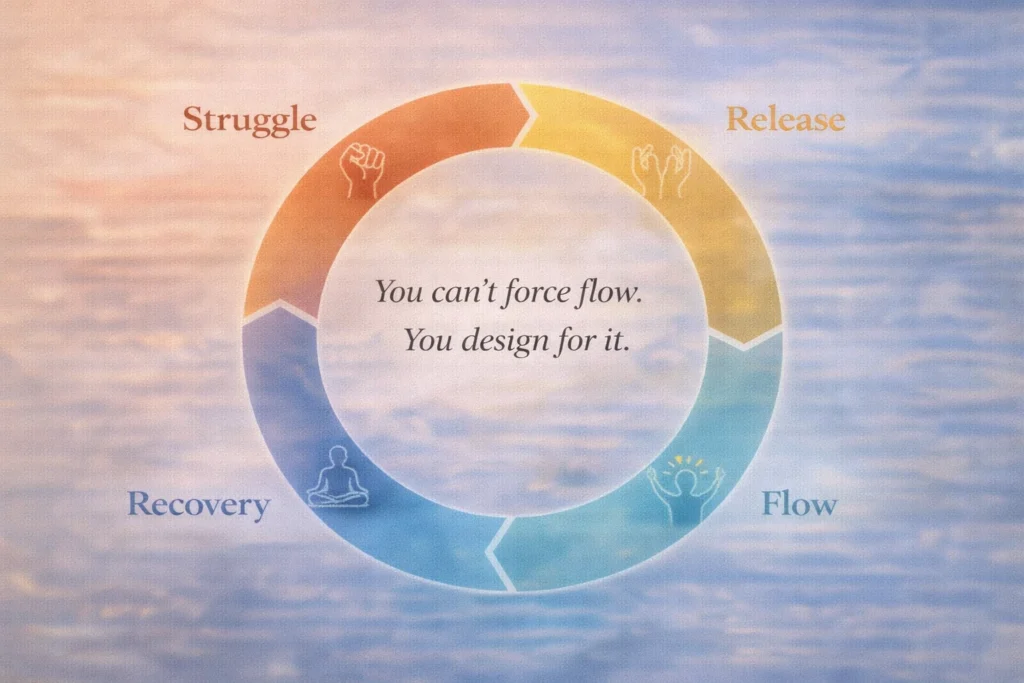
Flow doesn’t appear on demand. It follows a cycle:
- Struggle: You load the brain with information. This is uncomfortable.
- Release: You let go. Walk, meditate, distract.
- Flow: You hit the zone. Performance spikes.
- Recovery: You rest deeply. Integration happens.
Most people get stuck in struggle because they don’t allow release. High performers overwork and miss recovery.
To live in rhythm with the flow cycle, you must:
- Honor struggle without panic
- Build release rituals (e.g., movement, journaling, breathwork)
- Protect flow windows (2–3 hours of deep work)
- Prioritize recovery like revenue
Flow isn’t permanent — it’s cyclical. Respect the cycle and you increase the frequency.
-
Designing for Flow in the Digital Age
Today’s work environment is flow’s enemy:
- Notifications hijack attention
- Meetings fragment time
- Busyness replaces depth
To reclaim flow, you need environmental and neurological design.
Environmental Flow Design:
- Declutter your workspace (visual noise equals cognitive noise)
- Use time blocks (90–120 mins uninterrupted)
- Silence all alerts during flow windows
- Create a sensory anchor (candle, music, lighting)
Neurological Flow Design:
- Start your day with one “hard start” task
- Keep caffeine usage strategic (not reactive)
- Schedule “boredom time” to allow subconscious to connect dots
Flow doesn’t thrive in chaos. It blooms in crafted conditions.
-
Flow Rituals from the Field
Here are real examples from high-performing leaders:
Chiang Mai-Based Creative Director:
- Morning walk in silence
- 10-minute gratitude journaling
- 2-hour writing window with binaural beats
Bangkok Startup Founder:
- No meetings before 11 a.m.
- Deep work sprints Mon-Wed, external calls Thu-Fri
- Midweek float tank sessions for mental reset
Phuket Wellness Entrepreneur:
- Morning Muay Thai
- Ocean swim before investor updates
- Digital detox every Sunday
These are not productivity tools. They’re flow enhancers — integrated into life, not added onto it.
-
The Link Between Flow and Meaning
Flow is not just about performance. It’s deeply tied to fulfillment.
When you’re in flow:
- You forget ego — and feel connected to purpose
- You lose track of time — and gain a sense of timelessness
- You dissolve isolation — and tap into universal intelligence
This is why athletes, artists, and entrepreneurs report flow as one of the most meaningful states of their lives.
It aligns with the Eastern idea of dharma — purposeful action done in alignment with your inner nature.
High-performers who live in rhythm with flow are not just more productive — they are more present, fulfilled, and aligned.
Conclusion: Flow as a Way of Life
The future of high performance isn’t more hustle — it’s deeper neuro-alignment.
By designing for flow:
- You eliminate wasted motion
- You magnify creative breakthroughs
- You operate from clarity, not pressure
In rhythm, flow becomes not just a state, but a strategy.
In the next chapter, we’ll explore how to translate all of this into real-world lifestyle design — with examples from Chiang Mai to Phuket.
Chapter 5: Lifestyle Design — From Chiang Mai to Phuket
Rhythm isn’t just about work. It’s about how you live.
The world is changing. Founders, creators, and advisors are no longer tied to boardrooms in skyscrapers. Instead, they’re designing lives around creative cycles, personal freedom, and location fluidity. In this final chapter, we look at lifestyle design through the lens of Thailand’s most inspiring creative hubs — Chiang Mai and Phuket — and offer a blueprint for building a rhythm-powered life.
Because the best-performing life is one that feels aligned.
-
The Rise of Lifestyle-Centric Work Models
Remote work, asynchronous teams, and borderless startups have opened up new questions:
- What kind of environment fuels my best thinking?
- Where can I live that honors my pace, health, and focus?
- Can I scale a business without sacrificing beauty and breath?
The answer is yes — with lifestyle design.
Lifestyle design means intentionally crafting your environment, schedule, relationships, and commitments around your values and energy. It means prioritizing life quality as a success metric — not just KPIs.
Thailand has emerged as one of the world’s top destinations for this shift. Let’s look at the two power zones leading this movement.
-
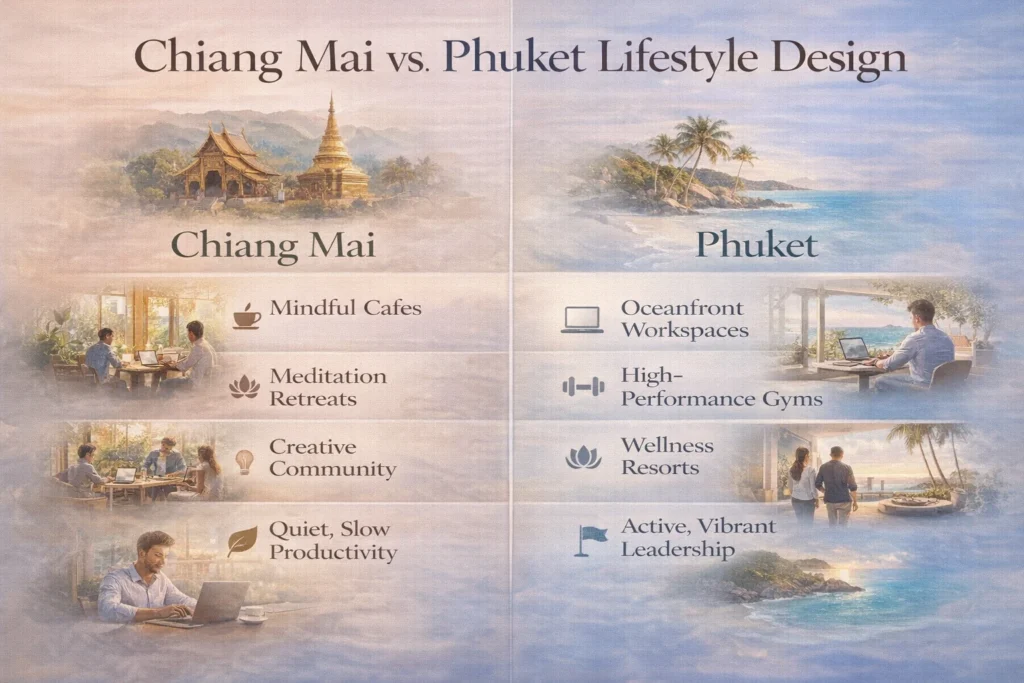
Chiang Mai: The Mindful Creator’s Playground
Chiang Mai has quietly become Southeast Asia’s creative capital.
Set against the mountains of Northern Thailand, it blends affordability, peace, and community in ways few cities can.
What makes it ideal for lifestyle design:
- Walkable old town filled with boutique cafes
- Massive digital nomad ecosystem
- Access to nature: waterfalls, hiking, meditation retreats
- Co-living/co-working spaces designed for creative rhythm
Chiang Mai is where founders go to think clearly, launch passion projects, or write their next book. It’s common to meet entrepreneurs who work 20–25 hour weeks but generate serious revenue — because their energy is optimized, not exploited.
Sample day in a Chiang Mai rhythm:
- Morning: Sunrise hike or silent meditation
- Midday: Deep work at a garden café with fast Wi-Fi
- Afternoon: Thai massage or coworking brainstorm
- Evening: Cultural immersion or creative journaling
In Chiang Mai, you don’t retire from ambition. You refine it.
-
Phuket: The Wellness Executive’s Blueprint
Phuket is where performance meets regeneration.
Once thought of as just a tourist island, it’s now a hub for wellness-driven founders, angel investors, and performance consultants. High-end resorts, private villas, and health-focused cafés create a backdrop for longevity-focused living.
Why Phuket supports peak living:
- World-class wellness infrastructure
- Clean food culture, daily access to ocean
- Abundance of space and luxury
- Proximity to international airports and capital cities
Phuket supports high intensity and deep rest — a rhythm few cities can manage. You can close deals in the morning, train Muay Thai in the afternoon, and journal under palm trees at dusk.
Sample day in a Phuket rhythm:
- Morning: Beach run, breathwork, green smoothie
- Midday: Strategy calls from sea-view office
- Afternoon: Private coaching or spa recovery
- Evening: Family dinner, digital sunset, slow stretch
In Phuket, the line between work and wellness disappears.
-
Building Your Rhythm-First Life
Here’s how to translate the Chiang Mai–Phuket blueprint to your life, wherever you are.
- Choose Your Core Environment:
- Are you more creative in solitude (Chiang Mai style)?
- Or do you thrive with luxury and vitality (Phuket style)?
- Build your base accordingly.
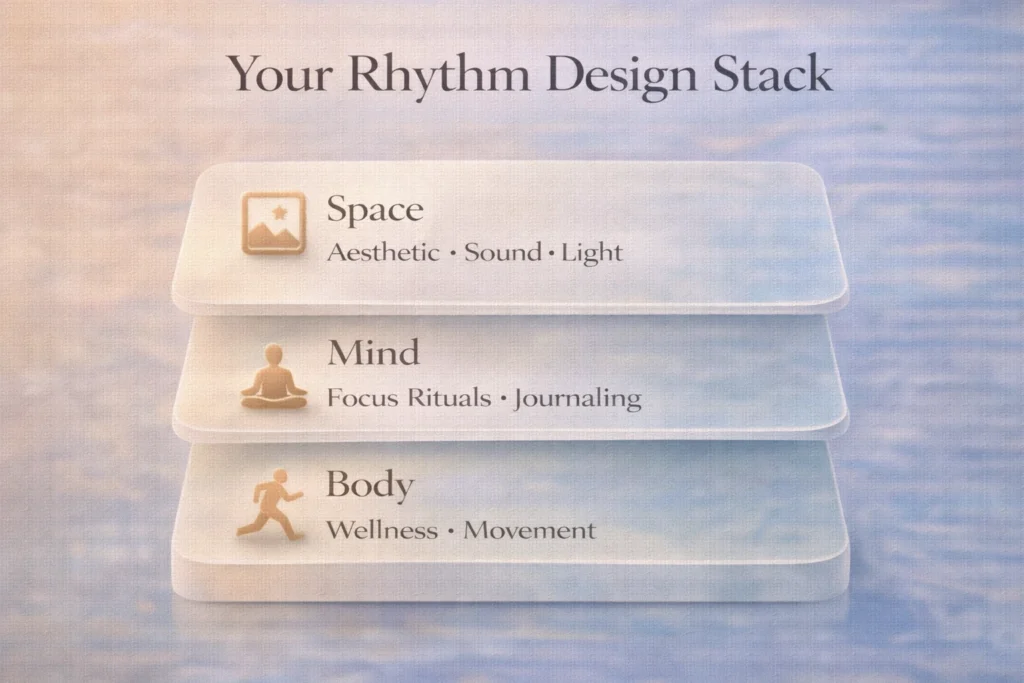
- Design a 3-Layer Lifestyle Stack:
- Body Layer: Movement, food, sleep rhythm
- Mind Layer: Focus rituals, journaling, creative cycles
- Space Layer: Visual aesthetics, lighting, noise control
- Map Your Energy Geography:
- Track which places fuel or drain you
- Use travel as rhythm — not escape
- Create quarterly mini-moves or base shifts
- Anchor Your Vision to a Place:
- Why not write your next strategic plan at a Chiang Mai villa?
- Why not host investor meetings after a Phuket spa weekend?
- Place influences pace. And pace is everything.
- Why Lifestyle is the New Leverage
The old model was:
- Sacrifice for 10 years, retire early, enjoy later
The new model is:
- Live now in rhythm, with energy, wellness, and clarity baked in
Today’s smartest founders don’t wait for weekends. They design lives where every day holds clarity and presence.
Your lifestyle is your operating system. Design it like you’d design a product:
- With feedback loops
- With version updates
- With beauty in mind
Conclusion: Rhythm is the Real Luxury
From Chiang Mai’s quiet gardens to Phuket’s sunrise waters, Thailand offers a living canvas for modern leadership.
Not the kind fueled by burnout. The kind that pulses with rhythm, alignment, and freedom.
As we’ve seen throughout this article — balance is broken. What high performers need is rhythm:
- In their energy
- In their habits
- In their location
- In their purpose
When you live in rhythm, you don’t just optimize performance. You upgrade your entire life.