

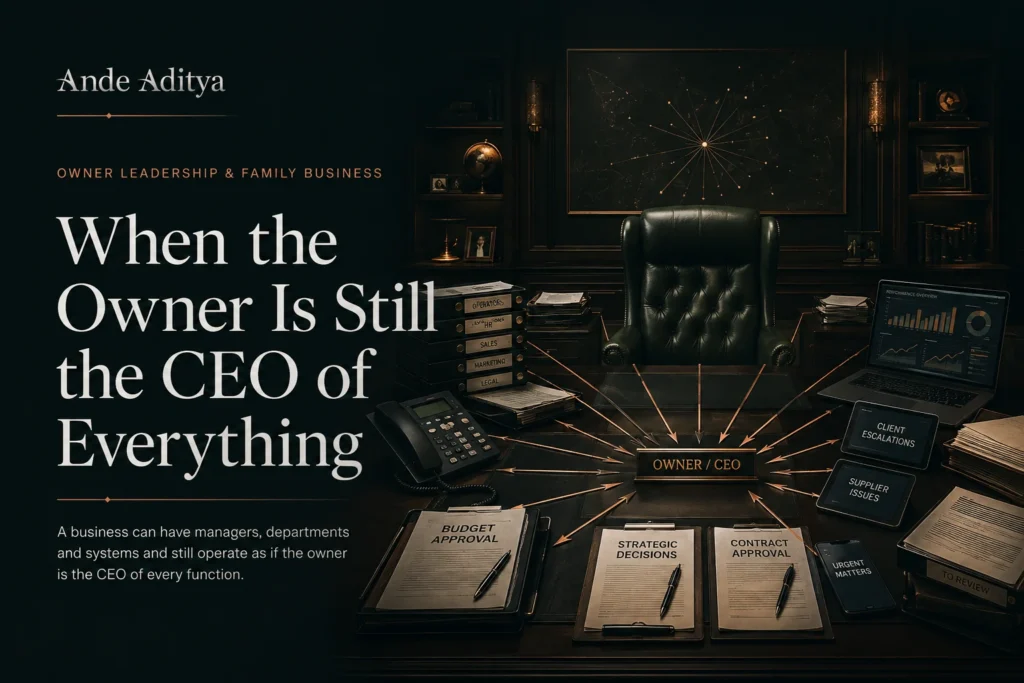
Many businesses look more professional from the outside than they operate on the inside. There may be department heads, financial systems, sales teams and monthly meetings, but important decisions still return to one person: the owner.
The owner approves discounts, resolves employee disputes, reviews purchases, speaks to key customers, decides recruitment, manages cash pressure and determines strategy. In effect, the owner remains the CEO of every function.
This model can work for a surprisingly long time. It often breaks when complexity increases: more people, more customers, more locations, thinner margins, a new generation entering the business or expansion into another market.
At that point, working harder is not the solution. The management model has to change.
The owner becomes the coordination system
In an owner-centric company, information travels upward because the owner is the person who can connect finance, operations, sales and relationships. That makes the owner valuable, but it also means the organisation never learns to coordinate laterally.
Managers become functional specialists rather than business leaders. They know their departments, but the owner remains the only person seeing the whole picture.
Why adding more managers often does not solve it
Owners sometimes respond by hiring stronger people. But if decision rights remain unchanged, even excellent managers quickly learn the existing culture. They prepare recommendations and wait for approval. The payroll becomes more senior while the operating model stays the same.
The first question is therefore not ‘Do I need a better manager?’ It is ‘What should this role truly own?’
A stronger management rhythm matters more than more meetings
Weekly and monthly management routines should create decisions, accountability and early visibility. They should not become reporting theatre.
A useful rhythm typically includes a small number of commercial, operational and financial measures, clear owners for each priority and an agreed process for issues that genuinely need escalation.
The owner’s role should move upward
As the company matures, the owner should gradually spend more time on direction, capital, leadership, major relationships and exceptional decisions—and less time on routine approvals.
This does not mean becoming distant. It means reserving owner attention for areas where owner judgment creates the most value.
A practical transition
Map recurring owner decisions
For two or three weeks, list every decision that comes to the owner. Patterns emerge quickly. Many of these decisions can be delegated, codified or moved into a regular review process.
Create authority bands
Define financial and operational thresholds. Managers should know what they can decide, what they must inform and what requires owner approval.
Make accountability visible
A delegated decision should have an accountable owner and a measurable outcome. Delegation without review becomes abdication; review without authority becomes micromanagement.
Build a second line of coordination
If all cross-functional issues require the founder, establish a management forum or a strong integrator role that can coordinate across departments.
The test
Ask a simple question: if the owner is unavailable for two weeks, what stops? The answer reveals the actual organisation chart more accurately than the one hanging on the wall.
The objective is not to make the owner irrelevant. It is to ensure that the business can operate with strength while the owner focuses on the few decisions that truly deserve owner attention.
Related on AndeAditya.com: Business Support • About Ande • Private Conversation