

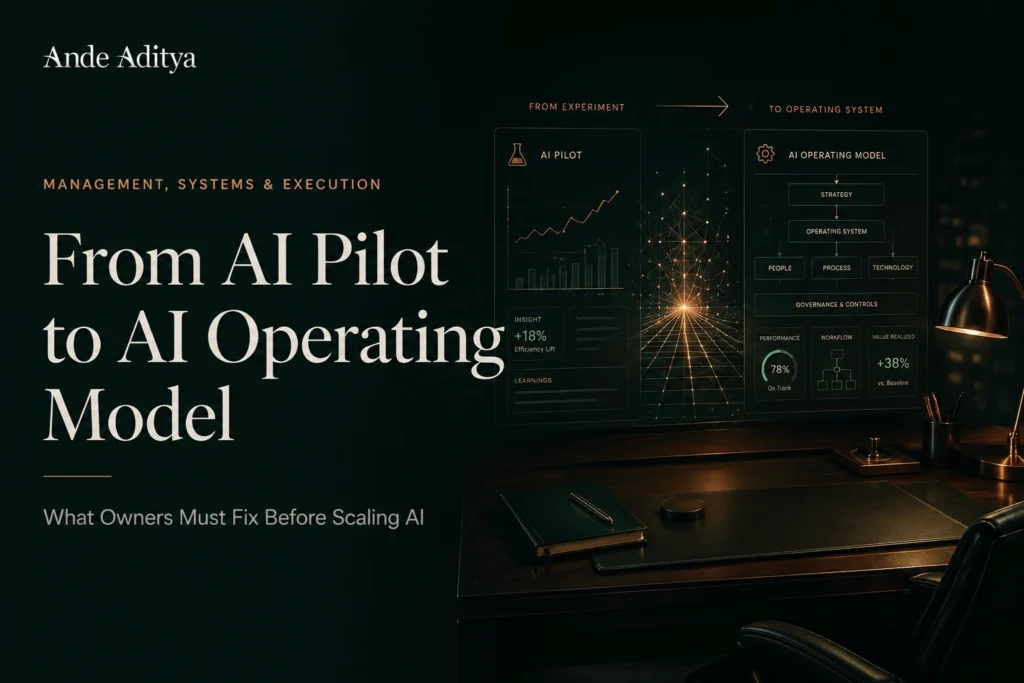
In the first phase of AI operating model, the question was simple: Which tools should we try? In 2026, that question is already becoming outdated. Most leadership teams have seen enough demonstrations, copilots and experiments to know that AI can be useful.
The harder question is now: How do we make it part of the operating model without creating another layer of fragmented technology?
This is where many companies will separate into two groups. One group will accumulate AI subscriptions, isolated pilots and enthusiastic users. The other will redesign selected workflows, establish ownership, improve data discipline and make AI measurable. The second group is more likely to create durable value.
McKinsey’s 2026 organisational work reinforces a broader point: technology is reshaping organisations, but performance still depends on how work, accountability and decision-making are designed. AI does not remove that requirement. It makes it more visible.
Why pilots stall
The problem is interesting but not economically important
A useful demo is not necessarily a useful business case. AI should be attached to a real operating outcome: faster sales response, lower error rates, improved forecasting, reduced administrative load or better decision quality.
The process is already broken
Automating a weak workflow usually creates a faster weak workflow. Before introducing AI, simplify the process and clarify what a good outcome looks like.
Nobody owns the result
IT may implement the tool, but the business function must own the outcome. Without accountable ownership, pilots remain experiments.
Data and permissions are treated as afterthoughts
AI systems become operational only when access, confidentiality, data quality and auditability are designed deliberately.
The five parts of an AI operating model
1. Business outcomes
Every use case should begin with a measurable problem rather than a technology feature.
2. Process design
Define where AI enters the workflow, what it changes and where human review remains necessary.
3. Data discipline
Clarify which data can be used, where it comes from, who owns it and how sensitive information is protected.
4. Human accountability
AI can recommend, draft, classify and predict. Someone still needs to be accountable for the final business result.
5. Governance and review
Decide how performance, errors, security issues and unintended consequences will be monitored over time.
Owners should resist two extremes
The first extreme is to move too slowly because every AI use case feels risky. The second is to move too quickly because the technology feels inevitable.
A better approach is controlled speed. Select a small number of high-value workflows, define the operating standard, measure the result and expand only when the process is stable.
The most valuable AI capability may eventually be organisational learning: the ability to test, integrate, govern and improve new technology faster than competitors. That capability belongs to management, not to a software vendor.
What I would ask in an owner review
Where is management time being wasted repeatedly?
AI is particularly useful where high-volume information work is consuming capable people.
Which decisions depend on fragmented information?
AI can help synthesise information, but only if data ownership is clear.
Which workflows have measurable economics?
Time saved is useful only if it translates into capacity, service quality, control or financial value.
Where could AI create unacceptable risk?
Customer data, confidential information, financial decisions and regulated processes deserve tighter controls.
Who will own adoption after the pilot?
If the answer is “the AI team,” the operating model is probably incomplete.
The real AI advantage
Tools will continue to change. The companies that benefit most will not be the ones that chase every new model. They will be the ones that can convert useful technology into disciplined execution.
The owner’s role is to ensure AI investment is connected to priorities, accountability and measurable operating improvement. The technology matters. The operating model matters more.
Related on AndeAditya.com: Business Support • About Ande • Private Conversation