

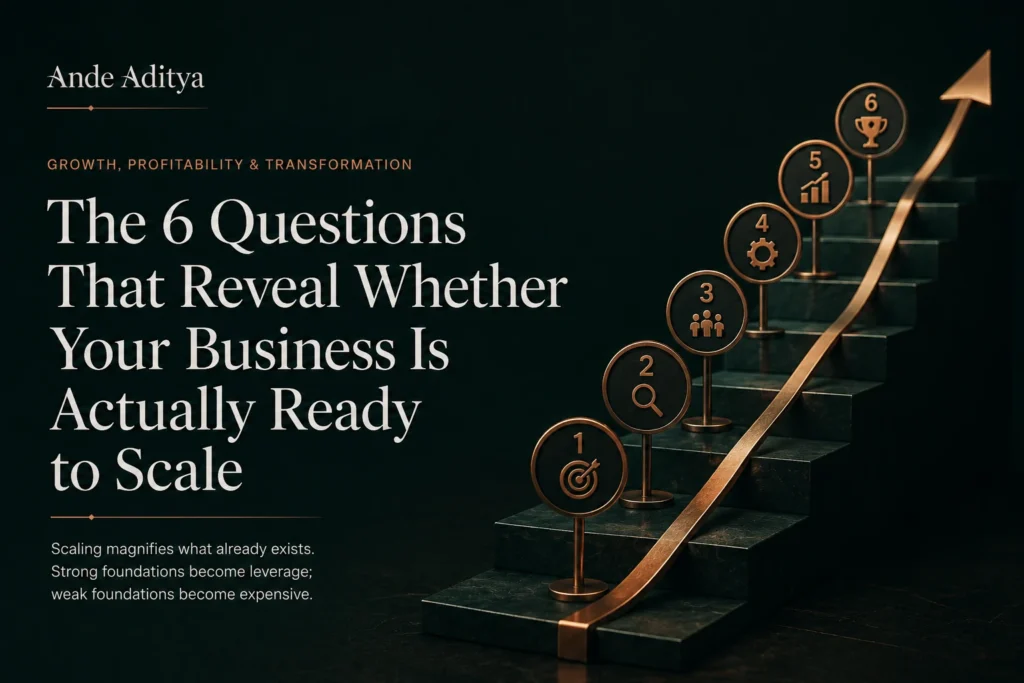
Scaling is one of the most overused words in business. It is often treated as an ambition rather than an operating condition.
The real question is not whether a business wants to grow. Most do. The question is whether the current model can absorb more customers, people, capital and complexity without breaking margin, service quality or management control.
Scaling magnifies what already exists. A strong operating model gains leverage. A weak one simply produces larger problems.
Before committing to the next stage of growth, I would ask six questions.
1. Is the business economically attractive before it scales?
Scaling does not repair weak unit economics. If pricing is poor, margins are inconsistent or customer acquisition is too expensive, expansion can accelerate losses.
The first test is whether the core business produces enough contribution to support the additional management, systems and capital that growth will require.
2. Can managers make decisions without the owner?
If every important decision still returns to the founder, scale will increase the decision queue. Growth requires authority to move outward while information moves upward.
A business that cannot operate for a short period without constant owner intervention is not yet structurally ready for rapid expansion.
3. Are the processes repeatable?
Successful scaling depends on repeatability. Sales qualification, onboarding, purchasing, delivery, collections and customer service should not rely entirely on individual memory.
This does not require bureaucracy. It requires enough standardisation that quality can survive more volume and more people.
4. Is cash flow strong enough to fund growth?
Growth consumes cash before it produces it. Inventory, receivables, hiring, marketing and new facilities may all require funding ahead of revenue.
A scaling plan should therefore include a realistic cash conversion view, not only a profit forecast.
5. Does the management information show problems early?
As complexity increases, owners cannot manage by intuition alone. The business needs a small set of reliable indicators that show margin, pipeline, operations, cash and risk before problems become obvious in the financial statements.
6. Is the opportunity worth the complexity?
Not every growth opportunity deserves to be pursued. A new geography or channel may add revenue but dilute management attention and weaken returns.
Good scaling includes saying no. The opportunity should strengthen strategic position, economics or capability—not simply make the organisation larger.
What a scaling-ready business looks like
A scaling-ready company usually has four characteristics: attractive economics, management depth, repeatable execution and adequate capital. Technology can improve each of these, but technology does not substitute for them.
The owner also has clarity about the next constraint. Is growth currently limited by demand, production, people, financing, distribution or management capability? Different constraints require different investments.
Scale in stages
I generally prefer staged expansion to large irreversible commitments. Test the model, measure the economics, strengthen the weak point and then commit more resources.
That approach may look slower initially, but it often produces faster and more sustainable growth because the business is learning before complexity becomes expensive.
The final question
If the business doubled in the next 18 months, what would break first? The answer is probably where the next management investment should go.
Related on AndeAditya.com: Business Support • Insights • Private Conversation