

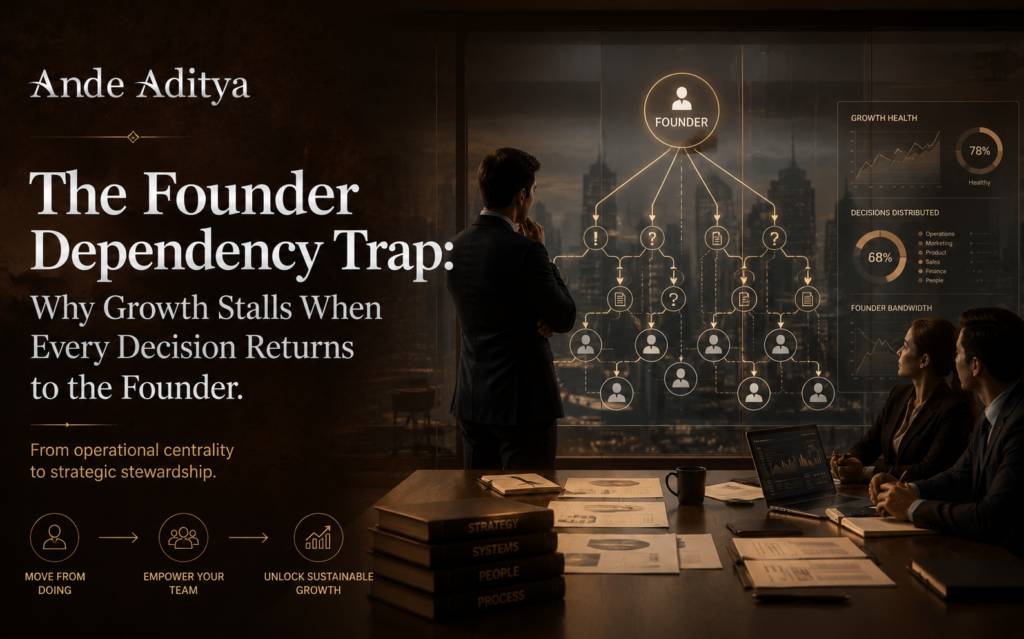
A business can grow in revenue, customers and headcount while remaining structurally small. The clearest sign is not the organisation chart. It is the flow of decisions. When pricing exceptions, hiring choices, customer problems, supplier negotiations, investments and internal conflicts repeatedly return to one person, the founder has become the operating system of the company.
In the early years, this concentration is often an advantage. The founder sees the whole picture, acts quickly and protects the standards that created the business. But the same behaviour becomes a constraint when complexity rises faster than the organisation’s capacity to decide and execute independently.
The founder dependency trap is therefore not a personality problem. It is a scaling problem—and, increasingly, a competitiveness problem.
“A founder should remain central to purpose, strategic direction and critical relationships—not to every routine decision.”
1. Why this issue matters now
The pressure on leaders has intensified. Companies are trying to grow while absorbing rapid shifts in technology, customer expectations, talent and cost structures. Yet many organisations have not redesigned the way work and decisions move through the business.
Microsoft’s 2025 Work Trend Index reported that 53% of leaders believed productivity needed to increase, while 80% of the workforce said they lacked the time or energy to do their work. Employees were interrupted, on average, every two minutes during core working hours—275 meetings, emails or chat interruptions per day. In a founder-led company, this “infinite workday” often converges on the founder: questions, approvals and escalations accumulate at the top instead of being resolved where the work occurs.[1]
The cost is not only founder fatigue. It is organisational latency—the time between a problem appearing and the business responding. A company may have talented people, but if they must repeatedly wait for approval, the practical capacity of the organisation is limited by one person’s calendar.
The growth environment is also less forgiving. PwC’s 2025 Global Family Business Survey found that only 25% of surveyed family businesses achieved double-digit sales growth, down from 43% two years earlier. In Thailand, only 44% reported sales growth, compared with 59% two years previously, and 22% achieved double-digit growth.[2][3] External volatility clearly matters, but periods of slower growth make internal execution quality, decision speed and governance even more important.
2. How founder dependency develops
Founder dependency usually begins as founder effectiveness. Five early-stage behaviours create momentum—and later become bottlenecks if they are not redesigned.
The founder closes the important sales.
Customers trust the founder’s credibility, speed and commercial judgement. Over time, relationships remain personal rather than institutional. Account knowledge, negotiating context and renewal risk stay in the founder’s head.
The founder protects quality through personal review.
Reviewing every proposal or deliverable initially prevents mistakes. But when standards are not converted into checklists, examples, operating principles and measurable controls, quality remains dependent on the founder’s attention.
The founder solves exceptions personally.
Fast intervention is useful when the business is young. Later, teams learn that difficult issues will eventually be escalated, so they become skilled at presenting problems rather than resolving them.
The founder retains information to remain informed.
Important conversations happen through private calls, personal messaging and informal meetings. Because the organisation cannot see the same facts, it cannot reproduce the founder’s judgement.
The founder hires helpers instead of owners.
People are recruited to execute tasks, but not given a clearly owned outcome, decision authority or resources. The founder then concludes that the team “cannot take responsibility,” although the role was never designed to carry it.
This creates a self-reinforcing loop: the founder intervenes because the team is not ready; the team remains unready because the founder continues to intervene.
3. Valuable founder involvement versus unhealthy dependency
The objective is not to remove the founder. Founder insight, networks, risk appetite and cultural influence can remain an exceptional source of advantage. The issue is whether the founder is adding unique value or compensating for missing organisational capability.
|
VALUABLE FOUNDER INVOLVEMENT |
UNHEALTHY FOUNDER DEPENDENCY |
|---|---|
|
Defines long-term direction and strategic priorities |
Approves routine transactions and operating exceptions |
|
Owns a small number of high-value external relationships |
Remains the only trusted relationship owner |
|
Allocates capital across major opportunities |
Approves normal spending within existing budgets |
|
Protects purpose, culture and non-negotiable standards |
Corrects every method and insists on personal preference |
|
Makes irreversible or enterprise-level decisions |
Reopens decisions already delegated to managers |
|
Coaches leaders and reviews outcomes |
Steps into tasks when execution becomes uncomfortable |
A useful test is this: if the founder becomes unavailable for two weeks, does the business merely miss the founder’s strategic contribution, or does routine execution materially slow down? The second outcome indicates dependency.
4. The evidence: decision quality improves when empowerment is designed
Delegation often fails because it is treated as a transfer of tasks rather than a transfer of decisions. McKinsey reports that only about one-quarter of surveyed organisations make delegated decisions with both high quality and speed. However, respondents who said employees were empowered and sufficiently coached were 3.2 times more likely to report high-quality, speedy delegated decisions.[4][5]
The important word is designed. Empowerment is not telling a manager, “You decide,” while withholding customer data, budget visibility, risk boundaries or access to the people needed for execution. Nor is it delegating a decision and later overruling it because the founder would have chosen differently.
Recent family-business research shows how widespread the underlying ambiguity remains. Deloitte’s 2025 global family-business analysis found that uncertainty over decision-making authority was the most frequently cited governance challenge, reported by 37% of respondents; succession planning for leadership transition followed at 36%.[6] In other words, many companies do not primarily suffer from a shortage of effort. They suffer from unclear decision rights.
5. Why traditional delegation fails
Founders often say they have tried delegation and it did not work. In practice, one or more of the following elements was missing:
- Authority without information: the manager is accountable for the result but lacks timely financial, customer or operational data.
- Authority without boundaries: the manager does not know the acceptable level of commercial, legal, reputational or financial risk.
- Authority without capability: the decision is transferred before the person has the judgement, exposure or coaching required.
- Accountability without authority: the manager owns the target but must obtain approval for the actions needed to achieve it.
- Delegation without tolerance for variance: the founder expects the manager to make exactly the same decision in exactly the same way.
- Reversal without learning: a delegated decision is overruled, but the reasoning is not discussed, so judgement does not improve.
- Escalation as convenience: issues are sent upward because escalation is faster or politically safer than resolving them across functions.
The result is “delegation theatre”: responsibility appears to move down, while real control and risk remain at the top.
6. The Decision Transfer Framework
A practical transition requires more than a new organisation chart. I use a six-part decision transfer framework that gradually relocates decisions while preserving visibility and control.
1. Build a decision inventory
For two to four weeks, record the decisions that reach the founder. Group them by category—sales, pricing, people, finance, customers, suppliers, delivery, compliance and investment. Note frequency, value at risk, reversibility and the person closest to the facts.
2. Segment decisions by strategic importance
Separate decisions into four classes: founder-reserved, approve, guardrail and fully delegated. Founder-reserved decisions should be few: strategy, major capital allocation, senior leadership appointments, significant legal or reputational exposure and a limited number of critical relationships.
3. Define decision rights in writing
For each recurring decision, state who recommends, who decides, who must be consulted and who must be informed. Avoid large committees. One person should normally hold the decision right and the resulting accountability.
4. Move information with authority
Provide the decision owner with the relevant dashboard, budget, customer history, contractual context and access to specialists. Information should be visible by design, not requested from the founder each time.
5. Establish guardrails and escalation triggers
Set thresholds: discount limits, hiring bands, credit exposure, contract deviations, cash commitments and reputational risks. Escalation should occur because a defined threshold has been crossed—not because a manager is uncomfortable.
6. Review judgement, not just outcomes
A good decision can produce a poor outcome, and a poor decision can temporarily produce a good one. Review the assumptions, evidence, alternatives and risk logic. This builds independent judgement instead of compliance.
A simple decision architecture
|
CLASS |
OWNER |
EXAMPLES |
FOUNDER ROLE |
|---|---|---|---|
|
Reserved |
Founder / board |
Strategy, major capital, CEO-level appointments |
Decide |
|
Approve |
Executive owner recommends |
Annual budget, major contract deviation |
Approve or challenge |
|
Guardrail |
Functional leader |
Pricing, hiring, customer remedies within limits |
Receive visibility |
|
Delegated |
Manager closest to work |
Routine purchasing, scheduling, service recovery |
No approval; review metrics |
7. Control does not require centralisation
Many founders resist decision transfer because they equate control with personal approval. But approval is only one form of control—and often the weakest at scale. Better control comes from visibility, standards, thresholds and consequences.
A scalable control system typically includes:
- A small set of outcome-based dashboards with agreed definitions and owners.
- Budgets and authority limits linked to roles rather than individuals.
- Exception reporting that highlights deviations instead of reviewing every normal transaction.
- Regular operating reviews focused on trends, root causes and commitments.
- Customer, quality and cash indicators that provide early warning.
- Post-decision reviews for high-impact or repeated decisions.
- A clear consequence system for repeated non-performance or risk breaches.
This changes the founder’s question from “Did you ask me?” to “Did you act within the agreed principles, use sound judgement and deliver the expected outcome?”
8. The founder’s role must be redesigned—not reduced
Once routine decisions begin moving outward, founders often experience an uncomfortable gap. Their identity has been built around being needed, informed and involved. Unless a higher-value role is deliberately defined, they may return to operations simply because operations are familiar and immediately rewarding.
The founder’s next role should concentrate on work that is difficult to delegate and disproportionately valuable:
- Strategic direction: choosing where the company will and will not compete.
- Capital allocation: deciding which opportunities, markets and capabilities deserve investment.
- Leadership architecture: appointing, coaching and evaluating the senior team.
- Institutional relationships: protecting a limited number of high-value customer, investor, government or partner relationships.
- Culture and governance: defining the principles that guide decisions when the founder is absent.
- Future building: identifying the next growth platform, partnership, acquisition or transformation.
This is the shift from operational centrality to strategic stewardship. The founder remains influential, but no longer functions as the company’s universal routing point.
9. The human side: managers must be able to carry the load
Founder dependency cannot be solved by removing approvals while leaving the management layer weak, overloaded or unclear. Gallup’s workplace research has repeatedly linked manager quality and engagement to organisational performance. Its 2025 global report estimated that falling employee engagement in 2024 cost the world economy US$438 billion in lost productivity.[7] More recent Gallup data show manager engagement continuing to weaken in several regions, reinforcing the need to invest in management capacity rather than simply flattening structures.[8]
For a founder-led SME or family business, this means the transition must include management routines: clear one-to-ones, role scorecards, decision coaching, cross-functional forums and direct feedback. A title does not create a manager. Repeated exposure to real decisions, supported by clear standards and consequences, does.
10. A 90-day transition plan
The founder dependency trap should not be addressed through a dramatic withdrawal. A staged transition reduces risk and creates evidence that the system can work.
|
PERIOD |
FOCUS |
OUTPUT |
|---|---|---|
|
Days 1–30 |
Observe and classify |
Decision inventory; bottleneck map; five to ten recurring decisions selected for transfer |
|
Days 31–60 |
Transfer with guardrails |
Named decision owners; thresholds; dashboards; escalation rules; weekly decision reviews |
|
Days 61–90 |
Stabilise and expand |
Founder stops pre-approving selected decisions; outcome reviews; second wave of transfers; role gaps addressed |
During this period, track four practical indicators:
- The number of routine decisions reaching the founder each week.
- Average time required to resolve customer and operating issues.
- The proportion of escalations caused by a genuine threshold breach versus uncertainty.
- The founder’s time allocation between operations, leadership, strategy and external growth.
The objective is not zero founder involvement. It is a deliberate shift in the quality of that involvement.
11. Signals that the organisation is becoming founder-independent
- Managers arrive with recommendations, assumptions and trade-offs—not only problems.
- Customers know and trust more than one senior relationship owner.
- Meetings end with one named decision owner and a clear date.
- Routine exceptions are resolved within agreed commercial and risk thresholds.
- Performance information is available without asking the founder to reconstruct it.
- The founder can be absent without approvals, cash collection or service recovery slowing materially.
- Senior leaders challenge the founder constructively because roles and governance are clear.
12. A final perspective
After working across businesses, industries and markets for more than three decades, I have seen that founders rarely become bottlenecks because they want to obstruct growth. They become bottlenecks because their personal judgement, relationships and urgency created the company—and the organisation never converted those strengths into repeatable capability.
The answer is not to professionalise the soul out of the business. Nor is it to force a founder into a ceremonial role. The answer is to institutionalise what works: decision principles, customer knowledge, operating standards, financial discipline and accountability.
A mature organisation does not need less leadership from the founder. It needs the founder’s leadership applied at a higher level.