

Introduction: Growth deserves a different definition
For much of my entrepreneurial journey, growth was associated with a larger office, more employees, additional markets and a wider range of services. Each of these could be a reasonable investment. Yet the longer I have worked with business owners, the more I have come to question whether the size of an organisation tells us anything useful about its strength.
A company can report higher revenue while generating less cash. It can recruit experienced managers while leaving important decisions with the founder. It can invest in sophisticated technology while employees continue to maintain the same information in multiple spreadsheets. Expansion can conceal weaknesses that become painfully visible when demand slows.
As we prepare for 2027, I believe business owners should examine the relationship between the resources they commit and the value those resources produce. The objective is to build an enterprise capable of serving customers well, generating healthy returns and responding to change without carrying unnecessary commitments.
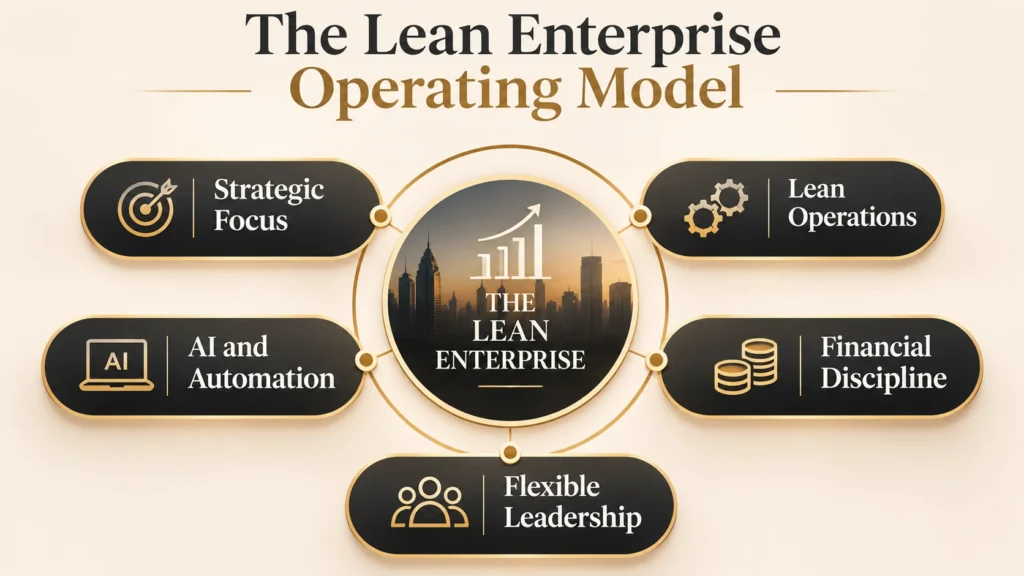
A lean enterprise is a business designed to maximise customer value and sustainable profitability by reducing waste, simplifying decisions, allocating resources carefully and improving the way work is performed. It applies the principles of continuous improvement across the organisation, from commercial operations to leadership and technology.
This does not mean every business should become smaller. A manufacturer may need additional production capacity; a distributor may need more inventory; a service business may need specialist talent. The question is whether each investment addresses a genuine constraint and whether the organisation can support it under less favourable conditions.
1. Understand the economics before changing the organisation
A lean transformation should begin with a financial diagnosis. I would ask the leadership team to explain which customers, products and activities generate cash, which absorb it, and why. A consolidated profit and loss statement is rarely sufficient for this purpose.
Consider a trading business with two customers. The first places large orders but demands long credit terms, frequent customisation and extensive after-sales support. The second orders smaller quantities, pays promptly and requires little intervention. The first may dominate the sales report while the second delivers a better return on the capital and management time invested.
The same principle applies to a technology company. A development contract may appear attractive until the cost of unbilled engineering time, repeated scope changes and delayed acceptance is included. Revenue is important, but the quality of revenue determines how much freedom the business has to invest in its future.
Start by examining contribution margins after directly attributable costs. Then review working capital, receivable ageing, inventory commitments and the timing of debt repayments. Build a rolling cash forecast that distinguishes contracted income from speculative opportunities. Where possible, assign the cost of exceptional service requirements to the relevant customer or project.
For illustration, a company earning THB 10 million in monthly revenue with a 30% contribution margin and THB 2.8 million in fixed monthly operating costs earns THB 200,000 before interest and tax. If sales fall by 10%, assuming the same contribution margin and fixed costs, it moves into a THB 100,000 operating loss. Reducing avoidable fixed costs by THB 400,000 would lower its monthly break-even revenue from approximately THB 9.33 million to THB 8 million. The example is hypothetical, but it shows why cost structure matters as much as the sales target.
Do not interpret the calculation as a reason to remove essential capacity. A reduction that damages customer retention or creates quality failures can cost more than it saves. The purpose of the exercise is to understand which costs are necessary to deliver the proposition and which exist because nobody has challenged them.
2. Simplify the business portfolio before simplifying the headcount
Many founders accumulate activities over time. A promising opportunity becomes a new service, a customer request becomes a permanent capability, and an experimental venture becomes another management responsibility. Individually, these decisions may have been sensible. Collectively, they can create an organisation that is difficult to manage.
I would classify each business line according to its economics, strategic relevance and the attention it requires. Some activities generate dependable cash and deserve protection. Others have credible growth potential but need a defined investment period. A third category may have limited prospects and consume resources that could be used elsewhere.
The difficult part is separating commercial judgement from emotional attachment. A founder may have spent years building a particular division and may be reluctant to acknowledge that its market has changed. Past investment deserves respect, but it cannot by itself justify future expenditure.
A portfolio review should lead to explicit decisions: invest, maintain, redesign, partner or exit. Each decision needs an owner, a financial limit and a review date. If a new venture is allowed six months to demonstrate demand, management should agree in advance what evidence would justify further funding. Otherwise, the review becomes another opportunity to postpone a difficult conversation.
For family businesses, this process can be particularly sensitive when different family members lead different divisions. An independent board advisor can help establish common evaluation criteria before individual businesses are discussed. The objective is to preserve enterprise value and family relationships while making decisions on comparable evidence.
3. Design the operating model around work that matters
The next question is how work should be organised. Traditional departments can provide useful accountability, but they can also create handoffs that delay customers and duplicate effort. Before changing the organisation chart, follow a real transaction from initial enquiry to final payment.
In a distribution business, for example, a customer quotation may pass between sales, procurement, finance and logistics. If each department maintains its own version of the order, employees spend time reconciling information. A shared order record, clear pricing authority and a defined exception process may remove several steps without removing any specialist expertise.
Distinguish core capabilities from enabling activities. Core capabilities are those that materially influence why customers choose the business. Enabling activities are necessary to operate but may be provided through shared teams or qualified external partners. The distinction depends on the company: logistics may be a support function for a software firm and the central competitive capability for a freight forwarder.
Where work is predictable and standardised, shared services can reduce duplication. Where work is highly specialised or intermittent, a retained external provider may be more appropriate. Where customer trust, intellectual property or regulatory accountability is at stake, internal ownership may remain essential even if parts of execution are outsourced.
Document service expectations, escalation routes, data access and continuity arrangements before transferring responsibility. A cheap supplier with poor response times can create expensive delays. The relevant comparison is total cost and service quality, including the cost of coordinating the relationship.
4. Use AI to improve workflows, not to accumulate subscriptions
Artificial intelligence gives businesses an opportunity to reconsider how knowledge work is performed. Its value depends on the process into which it is introduced. Buying multiple AI subscriptions without defining the problem can create another layer of overhead..

I would begin with a small number of repetitive, measurable workflows. A sales team could use AI to prepare a first draft of a proposal using approved product information. A sourcing team could extract comparable specifications from supplier quotations. A finance team could flag unusual transactions for human review. In each case, the system assists a defined task and an accountable person remains responsible for the outcome.
Before implementation, measure the current time, error rate and rework involved. After a pilot, compare the results, including the time employees spend checking AI output. A task that takes ten minutes to generate and forty minutes to verify may offer little improvement over a reliable manual process.
Data governance is equally important. Customer contracts, personal information, pricing arrangements and proprietary designs should only be processed through approved systems with suitable access controls and contractual protections. Employees need to know which information may be shared and which decisions require human approval. AI-generated content can be incorrect even when it appears convincing.
The commercial benefit comes when a successful pilot changes the workflow itself. If a report can be prepared automatically from trusted records, management should reconsider whether the old manual report is still needed. Running both processes indefinitely may increase the workload rather than reduce it.
For smaller enterprises, the opportunity is significant because they can often change processes without navigating multiple layers of approval. Start with tools that integrate with existing systems and avoid expensive custom development until the use case has been proven. For larger enterprises, establish common standards and allow departments to test within those boundaries.
5. Build leadership capacity without unnecessary hierarchy
One of the most expensive forms of organisational waste is waiting for a decision. A founder who must approve every quotation, recruitment request and supplier payment becomes a constraint on the company’s ability to operate. Hiring more managers will not solve the problem if authority remains unchanged.
A lean enterprise needs clear decision rights. Define who may approve expenditure, negotiate commercial terms, allocate resources and resolve customer exceptions. Set thresholds according to financial exposure and risk. Reserve genuinely strategic decisions for the board or owner, and allow operational decisions to be made by the people closest to the work.
Experienced leadership can also be accessed through different engagement models. An independent board advisor can provide perspective, challenge assumptions and support governance. A fractional CEO or country manager can take on specifically delegated executive responsibilities for an agreed mandate. These are distinct roles and should not be confused with a statutory director appointment or unrestricted authority.
A fractional leadership model is useful when the business needs senior expertise but cannot justify a permanent full-time executive, or when an owner needs support during a defined transition. The arrangement should include a fixed retainer, clear responsibilities, agreed availability, reporting and measurable outcomes. Where appropriate, performance incentives can supplement the base fee.
There are limits. A company facing daily operational emergencies may require a full-time executive. A regulated business may need designated officers with specific qualifications. The model must match the intensity of the work and the applicable governance requirements.
For a family enterprise preparing for succession, an external leader can help the next generation develop decision-making experience while the founder gradually steps away from daily approvals. The transition should be deliberate, with documented authority and regular reviews, rather than an informal transfer of responsibility.
6. Enter new markets with a lean local operating model
International expansion often exposes the difference between establishing a presence and building a business. Companies may commit to office leases, equipment, recruitment and administration before they understand how quickly local customers will adopt their offering.
Thailand is a useful example. A foreign technology company may need a small local team to support clients. An overseas distributor may need commercial representation and freight coordination. An international buyer may need a sourcing presence to evaluate suppliers and follow up on orders. Their operating requirements differ, even when the initial team size is similar.
A staged entry can help manage uncertainty. First validate customer demand and the regulatory route. Then define the local activities, the resources required and the expected commercial milestones. Establish the smallest credible operating platform that can deliver those commitments, and expand when demand justifies additional investment.
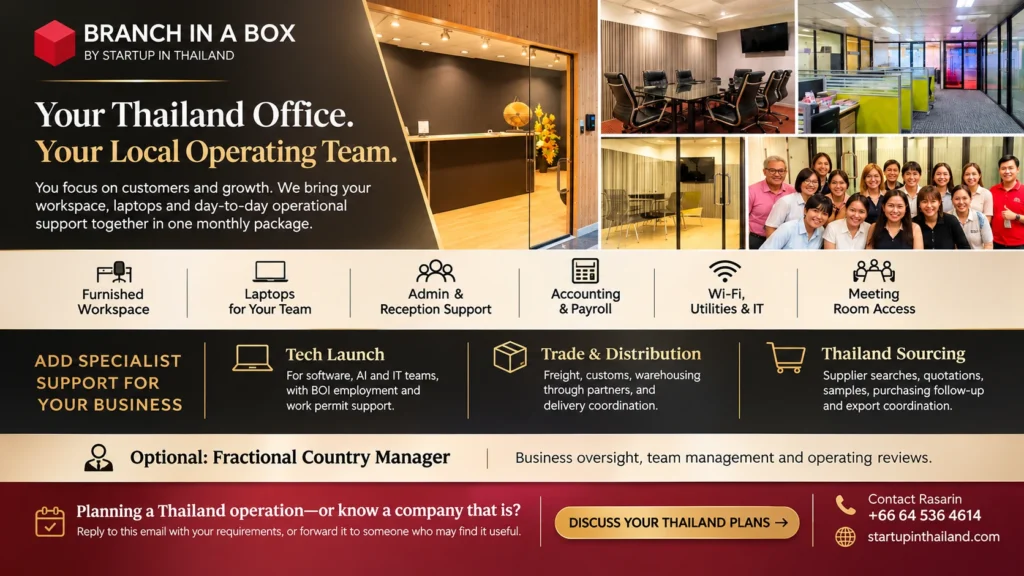
This is the thinking behind Branch in a Box by Startup in Thailand. The concept brings together furnished workspace in Asoke, Bangkok, laptops and agreed administrative, accounting and payroll support in a monthly package. Companies can add specialist support for technology operations, trade and distribution, or Thailand sourcing. Fractional country management can be scoped separately where senior oversight is needed.
The benefit is the ability to access a working local infrastructure without building every supporting function independently. The arrangement does not remove the need to determine the correct legal entity, licensing, tax treatment or employment structure. BOI-related employment and work permit support is subject to eligibility and approval. Freight, customs and warehousing services may involve qualified external partners.
Before choosing any managed operating model, compare the full monthly cost with a standalone office, including deposits, equipment, recruitment, administration and management time. Assess confidentiality, service levels and exit terms. A lean entry should preserve the option to expand, change direction or establish a larger independent operation later.
7. Protect people, knowledge and customer relationships
Cost reduction is sometimes mistaken for lean management. Removing experienced employees without understanding their responsibilities can create hidden dependencies and undermine service quality. The knowledge held by a long-serving operations manager may be difficult to replace, even if their work is poorly documented.
A better approach is to identify activities that add little value and involve employees in redesigning them. People who perform a process every day often know where delays originate. Ask them which approvals are redundant, which information is repeatedly requested and which customer problems could be prevented earlier.
As work changes, invest in practical upskilling. An administrator who learns to manage a shared workflow or use AI responsibly may become more valuable to the business. A salesperson who understands contribution margins can make better commercial decisions. Training should connect to actual responsibilities and measurable improvements rather than attendance alone.
Protect institutional knowledge through documented procedures, shared customer records and cross-training. Every critical process should have a backup owner. When a business relies on one employee or the founder to remember essential details, its apparent efficiency may conceal a serious continuity risk.
Customer experience should remain a guardrail throughout the transformation. Monitor complaints, delivery reliability and retention alongside financial savings. If the new operating model makes it harder for customers to obtain support, management needs to investigate before expanding the change.
8. A practical 90-day lean enterprise framework
The first 30 days should focus on diagnosis. Review the financial position, customer profitability, business portfolio and key workflows. Identify the decisions that repeatedly return to the founder. Establish baseline measures and agree on the constraints that matter most. Avoid announcing a broad restructuring before the evidence is available.
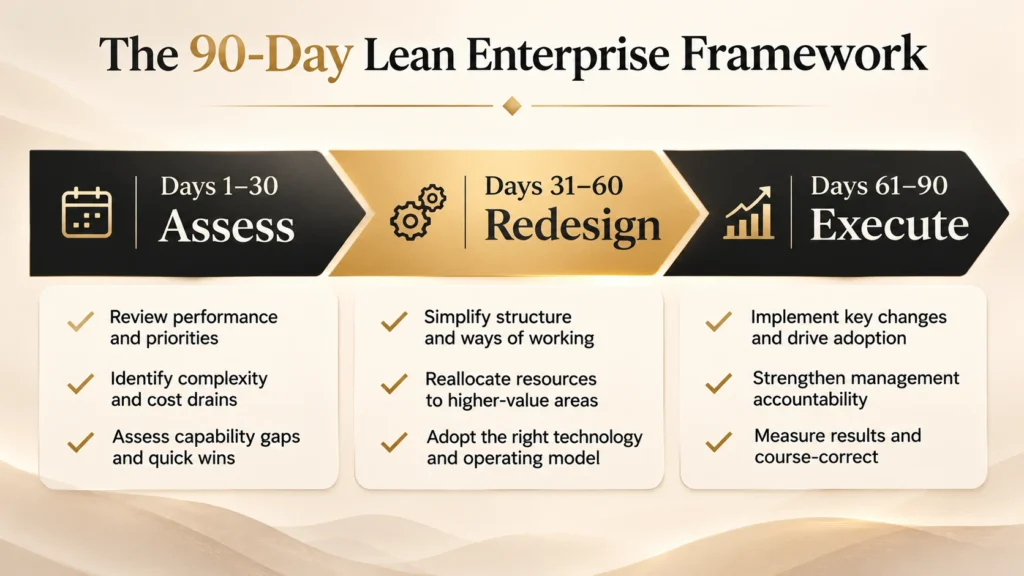
During days 31 to 60, select a limited number of interventions. Renegotiate an unnecessary commitment, simplify a recurring approval, pilot one AI-assisted workflow or consolidate duplicated administration. Assign each intervention an accountable owner and define the expected outcome. Communicate clearly with affected employees and customers where appropriate.
During days 61 to 90, evaluate the results. Compare actual savings with transition costs, and distinguish recurring improvements from one-off gains. Review whether customer service has changed and whether employees have gained usable capacity. Decide which interventions should become standard practice, which require modification and which should stop.
A monthly leadership dashboard can keep the programme grounded. I would include operating cash flow, contribution margin, fixed operating costs, overdue receivables, customer retention, delivery reliability and the time taken to resolve key decisions. Select measures relevant to the business rather than imposing a universal scorecard.
For AI initiatives, track verified hours saved, quality and adoption. For outsourced functions, track service levels and total cost. For fractional leadership, track agreed mandate outcomes rather than the number of meetings attended. Each measure should have a named owner and a consistent definition.
The board should review progress quarterly and challenge any initiative that produces savings at the expense of long-term capability. Lean management is a continuing discipline. A 90-day programme is simply a way to begin with manageable commitments and evidence.
9. Preparing for 2027: resilience before expansion
My preference for the coming year is to build businesses with enough financial and operational flexibility to respond to opportunities without being forced into them. A company with manageable fixed commitments and reliable cash generation can negotiate from a stronger position than one that needs every prospective contract to materialise.
Prepare several operating scenarios rather than relying on a single annual budget. Consider what happens if sales arrive later than expected, a major customer reduces orders or supplier costs increase. Identify the actions management would take in each case and the thresholds that would trigger them. The exercise is valuable even when the downside never occurs.
At the same time, protect the investments that will matter in three to five years. Technology capability, trusted customer relationships, product quality and leadership development may require expenditure today. Lean thinking should help fund those priorities by reducing spending elsewhere.
For owners approaching a different stage of their entrepreneurial journey, there is another benefit. A business with documented processes, capable managers and clear governance can operate with less dependence on the founder. That creates room for succession, new investments or a more balanced personal life.
The enterprise I would want to build for 2027 is one that knows where it earns money, understands what its customers value and can make decisions without unnecessary delay. Its size is secondary to its ability to perform consistently.

Frequently asked questions
What is a lean enterprise?
A lean enterprise applies continuous improvement and waste reduction across its business model, operations and leadership. Its purpose is to improve customer value, profitability and adaptability while protecting essential capabilities.
Is lean management the same as cost cutting?
No. Cost cutting targets expenditure. Lean management examines how resources create value and removes unnecessary work or commitments. It may involve investing in people, systems or capacity when those investments improve outcomes.
How can small businesses use AI to become leaner?
Start with repetitive tasks such as proposal drafting, document extraction and internal reporting. Measure time and quality before and after a pilot, use approved data controls and retain human oversight for important decisions.
When should a company consider a fractional CEO?
When it needs experienced executive leadership for a defined mandate but a full-time appointment is not commercially justified. Authority, accountability, availability and fees should be agreed in writing.
How can foreign companies establish a lean operation in Thailand?
Validate demand and legal requirements first, then consider a small local team supported by shared infrastructure and specialist services. Expand capacity as commercial milestones are achieved. Obtain qualified advice on entity, tax, employment and licensing requirements.