

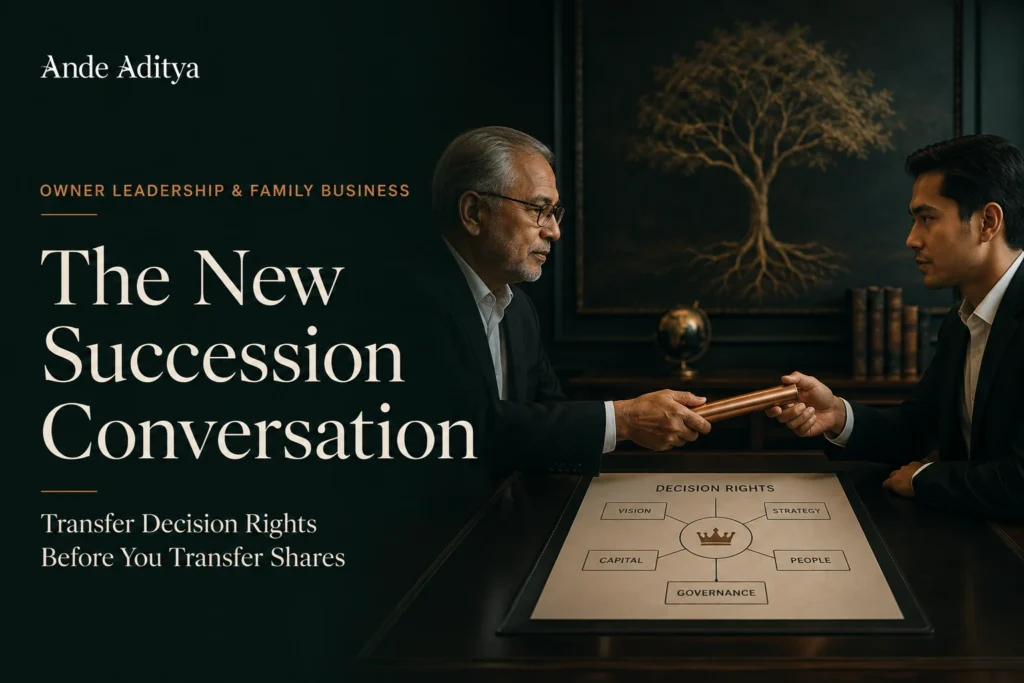
Family-business succession is often framed around shares: who will own what, when the transfer will happen and how the estate or legal structure will be arranged.
Those questions are important. But ownership transfer is only one part of succession. The harder transfer is invisible: judgment, relationships, authority, credibility and responsibility.
If the next generation receives shares before learning how to carry decisions, the family may complete the legal succession while leaving the operating succession unfinished.
This is why I prefer to think about succession as a sequence of decision-right transfers rather than one future event.
The difference between inheritance and succession
Inheritance transfers assets. Succession transfers the ability to steward those assets well.
A successor needs more than knowledge of the business. They need to understand how major decisions are made, why certain relationships matter, how risk is evaluated, when to say no and how to hold managers accountable without trying to prove authority.
Asia-Pacific families are increasingly seeking structured support around intergenerational wealth transfer. Reuters reported in 2026 on UBS research showing strong use of professional advice by next-generation families in the region. That reflects a wider reality: succession is becoming too important and complex to leave entirely informal.
A practical succession ladder
Stage 1: Observe decisions
The next generation attends selected owner and management discussions, learns context and sees how trade-offs are evaluated.
Stage 2: Recommend decisions
They analyse issues and make recommendations while the senior generation retains final authority.
Stage 3: Own bounded decisions
Specific categories—projects, business units, budgets or relationships—are transferred with clear limits and measurable accountability.
Stage 4: Lead strategic decisions
The successor begins leading major discussions while the senior generation shifts toward challenge, perspective and governance.
Stage 5: Carry full accountability
The business can operate under the successor’s authority, with the previous generation available by design rather than necessity.
What should transfer before shares
Customer and stakeholder relationships
Key relationships should know and trust the successor before a formal transition.
Management accountability
Senior managers must know who sets priorities, who reviews performance and who makes final calls.
Capital discipline
The successor should understand how the family thinks about debt, investment, dividends, risk and long-term value.
Decision boundaries
Everyone should know what the successor can decide independently and what still requires owner or board approval.
The right to make some mistakes
No successor becomes credible if every decision is corrected before consequences can be learned. Boundaries matter, but so does real responsibility.
The founder has a transition too
Succession is not only about preparing the next generation. It is also about redesigning the founder’s role.
Many founders struggle because “stepping back” sounds like becoming irrelevant. A better model is to shift from operating control toward selective strategic involvement, governance, relationships, capital decisions or new ventures.
The founder’s experience remains valuable. The goal is to use it where it creates leverage rather than where it prevents the next generation from becoming capable.
Succession becomes calmer when it is gradual
The best succession plans reduce drama by reducing surprises. Authority has already moved. Relationships have already broadened. Managers have already adjusted. The successor has already demonstrated judgment.
When the share transfer eventually happens, it confirms a reality that the business has already learned to live with.
That is a healthier form of continuity—for the family and for the company.
Related on AndeAditya.com: Business Support • About Ande • Private Conversation