

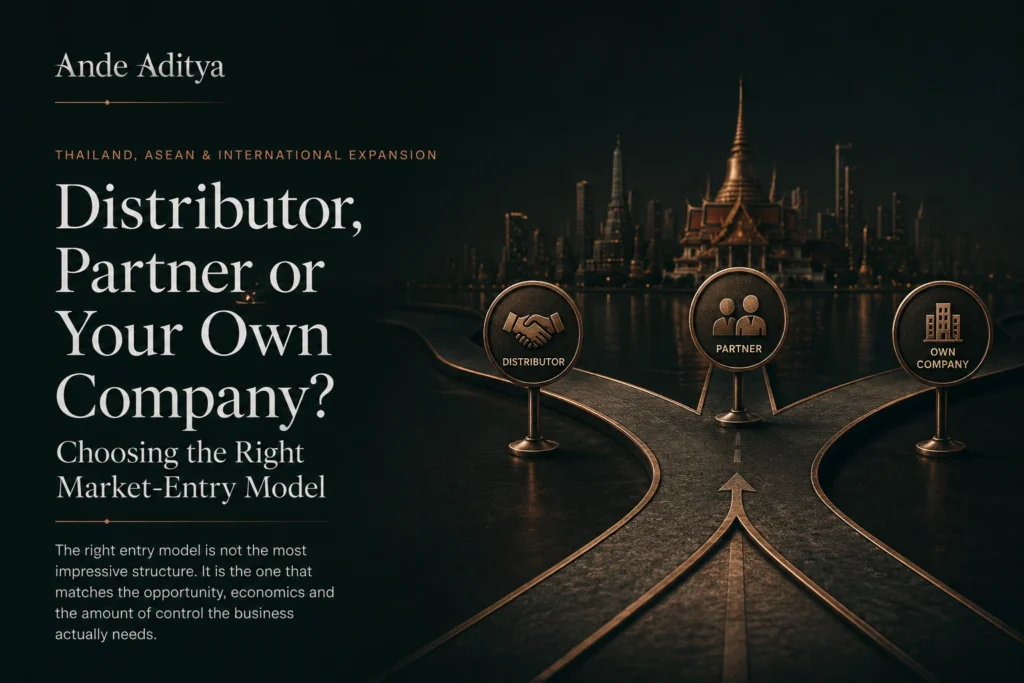
One of the first questions international companies ask when entering Thailand is structural: Should we appoint a distributor? Find a local partner? Establish our own company?
There is no universally correct answer. Each model creates a different balance of control, speed, cost, local knowledge and commitment.
The mistake is choosing the structure before understanding the commercial problem.
A distributor can be excellent when the business needs fast market access and local sales capability. A partnership can create relationships or capabilities the company cannot easily build alone. A direct entity provides greater control but also demands management, capital and operating readiness.
The decision should follow the strategy—not lead it.
Option 1: Distributor
A distributor can reduce fixed commitment and provide immediate access to local relationships, sales channels and market knowledge. This is attractive for companies testing demand or entering product categories where established channels matter.
The trade-off is control. Pricing, brand execution, customer information and strategic focus may be less direct. The key issue is not simply finding a distributor, but finding one whose economics and priorities make your brand important enough to receive attention.
Option 2: Strategic partner
A partner can contribute relationships, licences, facilities, technical capabilities, customers or capital. Partnerships are especially useful when local capability is difficult to replicate independently.
But partnerships create governance questions. Who decides? Who invests? Who owns customer relationships? What happens when priorities diverge? These issues should be addressed before enthusiasm turns into commitment.
Option 3: Your own company
A direct entity can provide stronger control over people, customers, pricing, data and long-term market development. It can also improve credibility when the opportunity justifies a permanent presence.
The cost is not only incorporation. A direct operation needs management, compliance, accounting, people, systems, cash and senior oversight. A company should not create this structure simply because it appears more serious.
A hybrid model is often practical
Many businesses do not need to choose one model forever. They may begin with representation or a distributor, learn the market, then establish a direct operation once volumes and relationships justify it.
Others maintain distributors while creating a small local team to manage key accounts, brand development and regional coordination.
Six criteria for choosing
1. Control
How important is direct control over price, customer relationships, service quality and brand?
2. Speed
How quickly must the business establish market presence?
3. Economics
What gross margin is available to support a distributor margin, local team or fixed operating cost?
4. Market knowledge
How much local knowledge is genuinely required, and can it be acquired without equity partnership?
5. Strategic importance
Is Thailand a test market, a meaningful long-term market or a potential ASEAN base?
6. Management capacity
Does headquarters have enough attention and capability to manage a direct operation well?
Due diligence is commercial, not only legal
Companies often perform financial and legal checks on a potential partner but spend less time understanding the partner’s actual sales organisation, competing brands, incentive structure, customer access and management attention.
Commercial due diligence should answer a simple question: what will this partner actually do for us after the agreement is signed?
Enter in stages when uncertainty is high
When the market is not yet proven, preserve optionality. Use a pilot, limited territory, performance milestones or review period before creating irreversible commitments.
The objective is to learn cheaply enough that the next decision can be made with better evidence.
Structure should follow opportunity
The best market-entry model is the one that creates enough local capability and control for the opportunity at hand—without building more complexity than the business can justify.
For companies evaluating Thailand or ASEAN entry, my Business Support work can help assess the opportunity, entry path, partner requirements and practical execution before larger commitments are made.
Related on AndeAditya.com: Business Support • About Ande • Private Conversation