

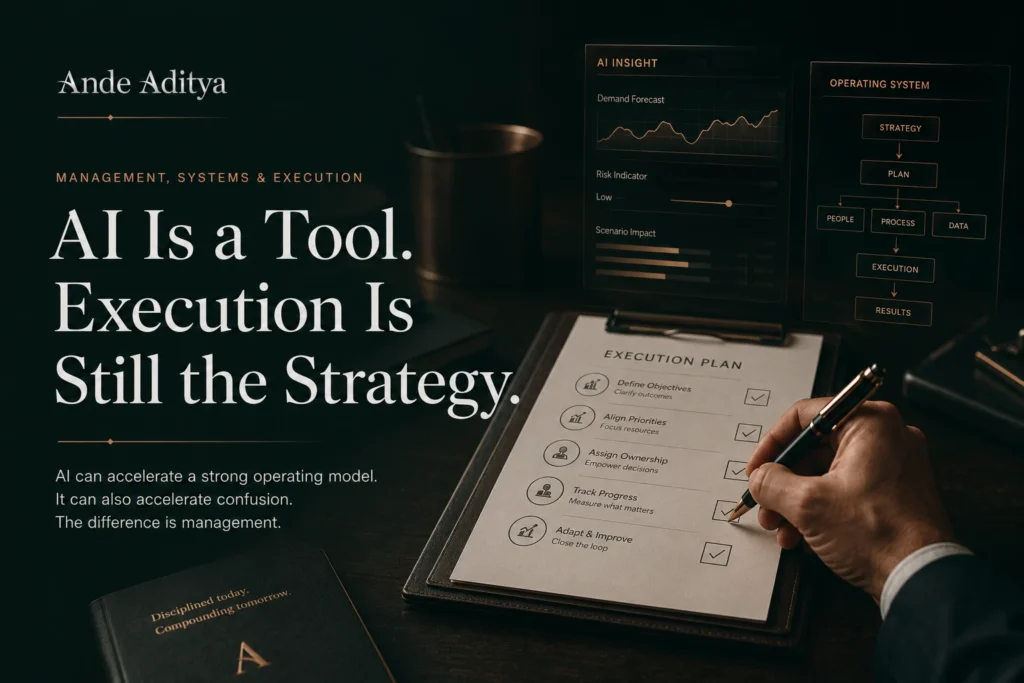
AI is now present in almost every business conversation. Owners are being told they need AI strategies, AI agents, AI automation, AI-enabled customer service and AI-driven decision making.
Much of this is directionally true. AI is becoming a useful operating tool. But I think many businesses are asking the question in the wrong order.
The first question should not be ‘Where can we use AI?’ It should be ‘What business problem are we trying to solve, and what needs to change operationally for the solution to work?’
AI can accelerate a strong process. It can also accelerate a weak one.
That is why execution remains the strategy.
Technology cannot repair unclear accountability
If nobody clearly owns a process, adding AI does not create ownership. It may produce faster outputs while responsibility remains ambiguous.
Before automating anything important, define who owns the outcome, who reviews exceptions and what decision the system is expected to improve.
Do not automate waste
A common technology mistake is to automate a process simply because it exists. The better sequence is: remove unnecessary steps, standardise what remains, then automate where technology creates measurable value.
Otherwise, the company becomes more efficient at performing work that should not exist.
Start with high-friction, measurable problems
Good AI use cases are usually specific: reducing repetitive document work, improving proposal preparation, summarising customer information, accelerating analysis, supporting knowledge retrieval or handling structured internal queries.
These are easier to test because owners can compare time, quality, cost and error rates before and after implementation.
Human judgment becomes more important, not less
As AI makes information and draft outputs cheaper, judgment becomes the differentiator. Someone still has to decide what matters, what is accurate, what is commercially sensible and what should be acted upon.
In owner-led businesses, this is especially important because context often sits in relationships and unwritten operating history.
Management systems determine whether AI scales
A useful pilot does not automatically become an organisational capability. Scaling AI requires data access, permissions, process ownership, training, risk controls and a clear operating standard.
Recent Deloitte research on family business technology transformation found that technology adoption is widespread but often partial rather than fully integrated. That reflects what I see more broadly: buying tools is easier than changing the operating model.
Five questions before implementing AI
1. What exact business outcome are we improving?
Time saved, errors reduced, response speed, decision quality, cost or revenue—choose something measurable.
2. Is the underlying process worth keeping?
Fix the workflow before automating it.
3. Who owns the result?
AI output still needs accountable human ownership.
4. What information can the system safely access?
Permissions, privacy and confidentiality should be designed at the beginning, not after deployment.
5. How will we know whether to scale?
Set a short pilot period and measurable success criteria.
The strategic advantage is not the tool
Most useful AI tools will eventually be available to everyone. Competitive advantage comes from how quickly a company can integrate technology into a disciplined operating model, learn from it and improve execution.
That is why I see AI as part of management and execution—not a substitute for either.
Related on AndeAditya.com: Business Support • Insights • About Ande